
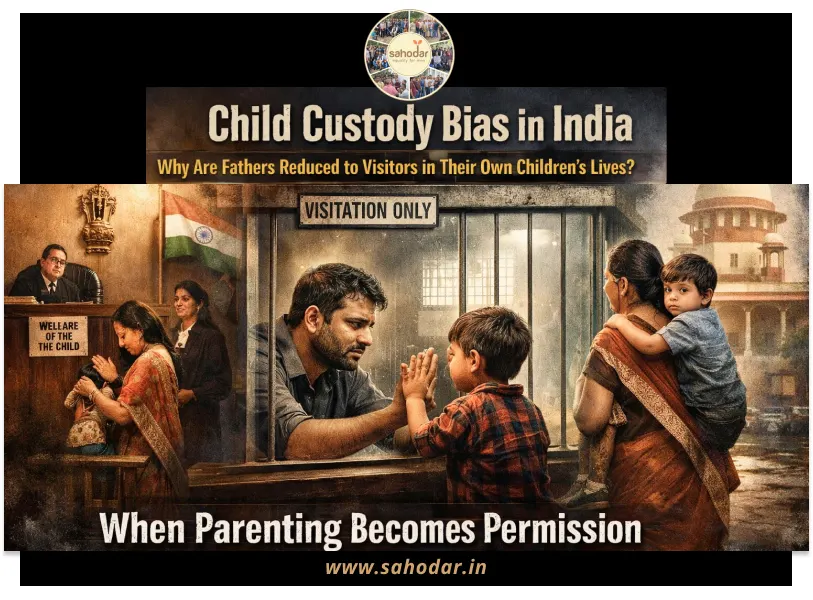
Indian custody law claims neutrality under the “welfare of the child” doctrine, but do courtroom outcomes tell a different story? Behind the language of welfare, a quiet pattern is reshaping fatherhood into supervised access.
NEW DELHI: In most of the custody matters. A father says he “gets to meet” his child for a few hours on Sundays.
Not raise. Not decide. Not participate. Just meet.
He doesn’t have custody — he has visitation. The child lives with the mother. He lives by a schedule.
That quiet normalization is where the real issue lies.
Across Indian courtrooms, fathers enter as equal parents but often exit as regulated visitors. The law speaks of the welfare of the child. The Constitution promises equality. Yet, in practice, custody frequently aligns with motherhood, while fatherhood is reduced to limited access.
If the statutes are gender-neutral, why do the outcomes so often appear otherwise?
The Legal Framework: Neutral on Paper
Child custody in India is primarily governed by:
- Hindu Minority and Guardianship Act
- Guardians and Wards Act
- Hindu Marriage Act
- Special Marriage Act
Across these statutes, one phrase dominates judicial reasoning: “welfare of the child.”
The Supreme Court of India has repeatedly held that the welfare of the child is paramount — above statutory rights, above parental claims.
In theory, this sounds unimpeachable. In practice, however, the interpretation of “welfare” often travels along predictable lines.
The Tender Years Doctrine: The Silent Presumption
While Indian statutes do not explicitly mandate maternal custody, courts have historically leaned on what is known as the “tender years doctrine” — the idea that young children are better off with their mothers.
Even where not formally invoked, it operates implicitly:
- Young child? Mother.
- School-going child? Likely mother.
- Allegations pending? Restrict father’s access.
Over time, this judicial inclination has hardened into expectation.
The result: Fathers rarely litigate for primary custody with realistic optimism. Most are negotiating visitation schedules from day one.
The Ground Reality: How Orders Typically Play Out
In contested matrimonial disputes, a common pattern emerges:
- Interim custody is granted to the mother.
- Father receives limited visitation — often:
- 2–4 hours per week.
- Alternate Sundays.
- Occasionally supervised.
- Overnight access becomes a battle.
- Vacation custody requires separate applications.
Interim orders frequently become de facto final orders because custody matters take years to conclude. By the time of final adjudication, the “status quo” argument dominates: the child has been living with the mother; continuity should not be disturbed.
Thus, temporary arrangements crystallize into permanent outcomes.
Parallel Proceedings and Tactical Litigation
Custody disputes rarely exist in isolation. They often accompany:
- Domestic violence proceedings.
- Maintenance claims.
- Criminal complaints.
Even without adjudication on merits, mere pendency of allegations can influence interim custody decisions. Courts, erring on the side of caution, restrict paternal access to “avoid conflict.”
The consequence is procedural punishment without proven guilt.
Structural Causes Behind the Bias
- Historical Social Assumptions
Indian courts do not function in a vacuum. Societal conditioning still perceives:
- Mother = primary caregiver.
- Father = financial provider.
Even when fathers are deeply involved in parenting, the courtroom narrative often defaults to stereotype.
- Judicial Risk Aversion
Custody decisions are emotionally sensitive. Judges may prefer continuity over experimentation. Awarding primary custody to a father is seen as disruptive; leaving the child with the mother appears safer.
- Status Quo Doctrine
Once interim custody is granted to one parent, courts hesitate to alter it. Time itself becomes a weapon.
The longer litigation continues, the weaker the father’s claim becomes.
Impact on Fathers
Reducing a parent to a visitor has consequences:
- Emotional alienation.
- Gradual erosion of the parent-child bond.
- Psychological stress and depression.
- Financial burden coupled with limited access.
Fatherhood becomes conditional — dependent on compliance, scheduling, and the goodwill of the custodial parent.
Impact on Children
The debate must return to its core: the child.
Children benefit from meaningful relationships with both parents. Internationally, jurisdictions such as:
- Australia
- United States
- United Kingdom
have progressively moved toward shared parenting frameworks or at least strong presumptions of joint involvement.
Indian courts, however, still predominantly operate within a primary-custodian model.
When one parent becomes peripheral, the child loses half of their emotional ecosystem.
Is “Welfare of the Child” Being Narrowly Interpreted?
A critical question arises:
Is welfare being equated with maternal comfort rather than balanced parenting?
True welfare should mean:
- Stability.
- Emotional continuity with both parents.
- Protection from parental alienation.
- Structured and enforceable access.
If a child grows up seeing one parent only twice a month, that is not shared parenting — it is controlled exposure.
Rethinking Child Welfare Through Shared Parenting
If child welfare is truly the guiding principle, then shared parenting must become part of the structural framework, not remain a judicial afterthought.
In Vivek Singh v. Romani Singh, the Supreme Court of India acknowledged the damage caused by parental alienation and stressed the importance of meaningful access to both parents. Yet, trial courts still largely default to primary custody models.
Similarly, in Gaurav Nagpal v. Sumedha Nagpal, the Court clarified that “welfare” includes emotional and psychological development — not merely residence stability. That principle logically supports shared parenting, but it is rarely operationalised as a presumption.
Reform must therefore move beyond discretion-driven outcomes and include:
- A statutory presumption of shared parenting, unless a parent is proven unfit.
- Time-bound adjudication of interim custody.
- Strict enforcement of visitation orders.
- Clear judicial recognition of parental alienation as harmful conduct.
- Structured mediation before adversarial escalation.
Custody cannot remain a tactical advantage in matrimonial litigation; it must reflect balanced parental responsibility.
Conclusion: From Visitor to Equal Parent
The law does not explicitly declare fathers secondary. Yet outcomes often communicate precisely that.
A parent does not cease to be a parent because a marriage collapses.
If Indian custody jurisprudence is genuinely committed to the welfare of the child, it must move beyond comfort-driven assumptions and toward equality-driven structures.
A father should not have to seek permission to be present in his child’s life.
He is not a visitor.
He is a parent.
FAQs
- Do fathers have equal custody rights under Indian law?
Yes. Statutes are gender-neutral and recognise both parents. However, in practice, courts often grant primary custody to the mother, especially in the early years. - Why do fathers usually get only visitation?
Courts rely heavily on the “welfare of the child” and status quo principles. Interim custody with the mother often becomes permanent, reducing fathers to limited access. - Can false allegations affect custody?
Yes. Even unproven allegations in parallel proceedings can influence interim custody orders and restrict paternal access. - Is joint custody recognised in India?
There is no statutory presumption of shared parenting. Joint custody is granted case-by-case and remains the exception rather than the rule. - What reform is needed?
A legal presumption of shared parenting, strict enforcement of visitation orders, and recognition of parental alienation are essential to ensure fathers are treated as equal parents, not visitors.