
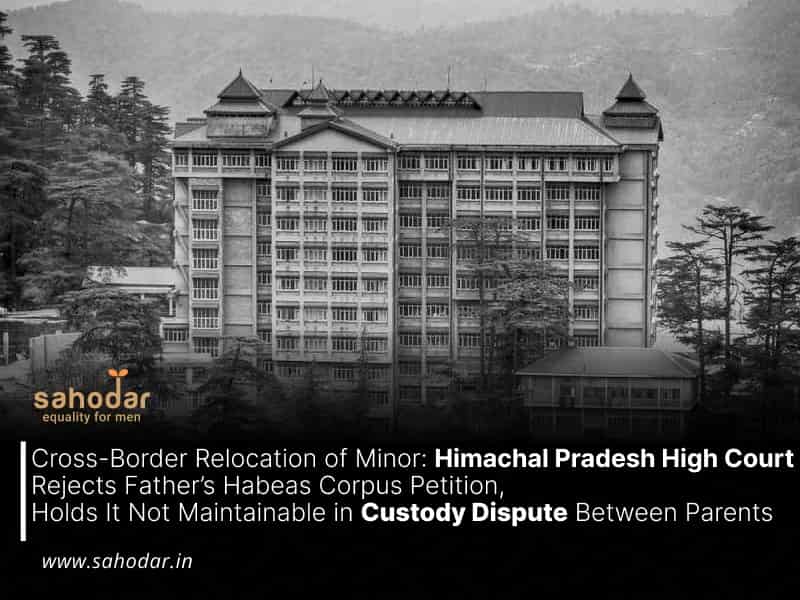
Can a father file Habeas Corpus after cross-border child relocation by the mother? The Himachal Pradesh High Court has held that in custody disputes between parents, such a plea is not maintainable and the remedy lies before the Guardian Court.
SHIMLA: In a recent child custody matter, the Himachal Pradesh High Court comprising Chief Justice G.S. Sandhawalia and Justice Bipin C. Negi dismissed a habeas corpus petition filed by a father seeking production and custody of his minor daughter. The Court made it clear at the outset that the dispute was between husband and wife and therefore required adjudication by the appropriate civil forum.
The petitioner approached the Court claiming that his wife had taken their minor daughter from Bangkok to Dharamshala without his consent. He sought immediate production of the child and restoration of custody, stating that the child’s welfare and education were being affected.
While examining the matter, the Court referred to its earlier reasoning on maintainability and reiterated that habeas corpus is an extraordinary remedy. The Bench clearly recorded:
“Habeas corpus proceedings is not to justify or examine the legality of the custody. Habeas corpus proceedings is a medium through which the custody of the child is addressed to the discretion of the court. Habeas corpus is a prerogative writ which is an extraordinary remedy and the writ is issued where in the circumstances of the particular case, ordinary remedy provided by the law is either not available or is ineffective; otherwise a writ will not be issued. In child custody matters, the power of the High Court in granting the writ is qualified only in cases where the detention of a minor by a person who is not entitled to his legal custody. In view of the pronouncement on the issue in question by the Supreme Court and the High Courts, in our view, in child custody matters, the writ of habeas corpus is maintainable where it is proved that the detention of a minor child by a parent or others was illegal and without any authority of law.”
The Court observed that in the present case, the child was with the mother, who is also a natural guardian. Therefore, it could not be treated as illegal detention in the strict legal sense required for invoking habeas corpus jurisdiction. The judges further noted that the father himself had clearly stated that the mother and child were in Dharamshala. In this context, the Bench remarked:
“Once there is a specific averment made as to where the respondent No. 3 is present namely in Dharamshala, it does not lie in the mouth of the learned Counsel to submit that the petition is being filed, as the whereabouts as such of the minor child are not known. Once the whereabouts as such are specific, the concerned Court would have such jurisdiction.”
This case highlights a recurring issue. When a father’s child is unilaterally relocated by the mother, the legal system often treats it as a routine matrimonial dispute rather than an urgent parental rights violation. The practical reality is that fathers, especially those residing abroad, are left to fight prolonged guardian court battles while their access to the child remains disrupted.
The Court ultimately declined to exercise writ jurisdiction and concluded: “Resultantly, we do not entertain the present petition keeping in view the settled position of law.”
While liberty was granted to approach the competent Guardian Court, the broader concern remains. For fathers seeking swift intervention when a child is removed without consent, the constitutional remedy of habeas corpus remains narrowly confined. The message is clear: even in cross-border child relocation scenarios, fathers must navigate lengthy civil proceedings rather than expect immediate constitutional protection.
EXPLANATORY TABLE: LAWS AND PROVISIONS INVOLVED
| Law / Provision | Purpose | How Applied in This Case |
| Article 226 of the Constitution of India | Empowers High Courts to issue writs, including Habeas Corpus, for the enforcement of rights | The father invoked writ jurisdiction under Article 226 seeking custody of his minor daughter |
| Writ of Habeas Corpus | An extraordinary constitutional remedy to secure release of a person from illegal detention | The Court examined whether custody with the mother amounted to illegal detention and held it did not |
| Guardians and Wards Act (Guardian Court Jurisdiction) | Provides statutory mechanism for deciding child custody based on evidence and welfare of the child | The Court held that custody disputes between parents must be decided by the competent Guardian Court |
| Tejaswini Gaud & others vs Shekhar Jagdish Prasad Tewari (AIR 2019 SC 2318) | Clarifies scope of Habeas Corpus in child custody matters | Relied upon by the petitioner to argue maintainability; distinguished by the Court |
| Saurav Rattan vs State of Himachal Pradesh (Cr.W.P. No. 11 of 2023) | Earlier High Court ruling on maintainability of Habeas Corpus in parental disputes | Followed by the Bench to hold that writ court should not decide custody disputes between husband and wife |
| Sayed Saleemuddin vs Dr. Rukhsana (2001) 5 SCC 247 | Supreme Court ruling limiting use of Habeas Corpus in custody matters | Cited to reinforce that alternative remedy must be used when available |
| Nithya Anand Raghavan vs State (NCT of Delhi) (2017) 8 SCC 454 | Addresses international child custody disputes and the welfare principle | Referred to while discussing limits of writ jurisdiction |
| Rajeswari Chandrasekar Ganesh vs State of Tamil Nadu (2023) 12 SCC 472 | Reiterates that writ jurisdiction is limited in custody disputes | Relied upon to support dismissal |
| Somprabha Rana vs State of Madhya Pradesh (2024) 9 SCC 382 | Clarifies the scope of Habeas Corpus in custody conflicts | Cited to affirm a settled legal position |
CASE DETAILS
- Case Title: Himanshu Dilip Kulkarni vs State of Himachal Pradesh & others
- Case Number: Cr. WP No. 7 of 2026
- Court: High Court of Himachal Pradesh, Shimla
- Neutral Citation: 2026:HHC:4020
- Date of Decision: 23.02.2026
- Bench:
- Hon’ble Mr. Justice G.S. Sandhawalia
- Hon’ble Mr. Justice Bipin C. Negi
- Counsels:
- For Petitioner: Mr. Aashutosh Srivastava, Advocate, Mr. Vishwajeet Singh, Advocate
- For Respondents: Mr. Rakesh Dhaulta, Additional Advocate General
KEY TAKEAWAYS
- When a mother unilaterally relocates a child, even across international borders, fathers are often denied immediate constitutional relief and pushed into lengthy guardian court litigation.
- The legal system treats parental child removal as a routine matrimonial dispute instead of recognizing the serious violation of a father’s custodial and access rights.
- Habeas Corpus, though meant to protect liberty, is narrowly applied in child custody matters, leaving fathers without urgent remedies in time-sensitive situations.
- The burden effectively shifts to fathers to initiate prolonged civil proceedings, during which access, bonding, and parental influence may already be damaged.
- There is an urgent need for gender-neutral enforcement of parental rights so that a father’s role is not reduced to secondary status when custody conflicts arise.