
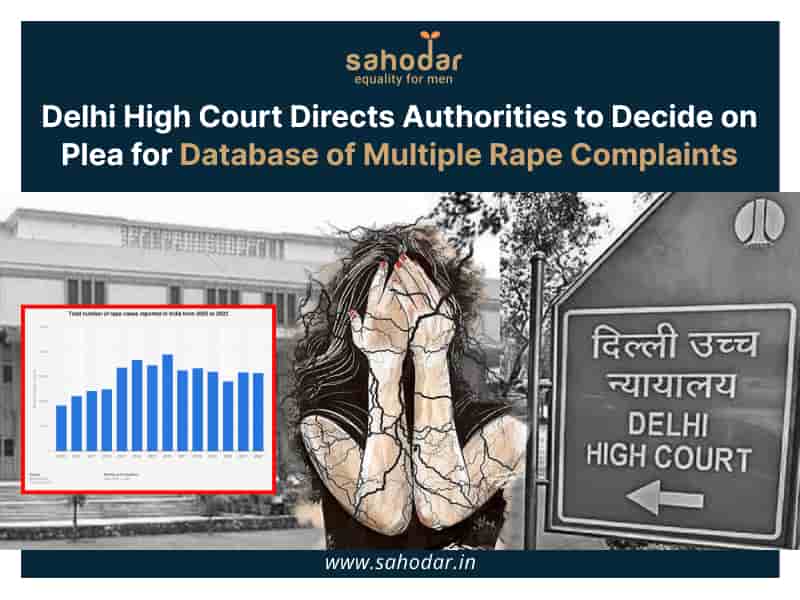
The Delhi High Court has recently directed the police and other competent authorities in the national capital to take a prompt decision on a plea seeking the creation of a database of individuals who file multiple complaints of rape or sexual offences. While acknowledging the concerns raised, the Court refrained from commenting on the petition’s merits and placed the responsibility for decision-making squarely on the executive authorities.
Court’s Observations
Bench Composition
The matter was heard by a division bench comprising Chief Justice D.K. Upadhyaya and Justice Tushar Rao Gedela.
Court’s Stance
The judges noted that the petitioner had already approached the Delhi Police and other authorities with his representation. Therefore, it was for the concerned bodies to take an “informed decision.”
The Court remarked:
“Without expressing any merit on the issues raised, the petition is disposed of with the direction to the authorities to take an informed decision on the petitioner’s representation with expedition.”
The bench further emphasised that policing strategies are best determined by the authorities, who are in a better position to decide how law enforcement mechanisms should operate.
The Petitioner’s Plea
Demands Raised
The PIL was filed by Shonee Kapoor (Co-founder Sahodar Support Group), represented by advocate Shashi Ranjan Kumar Singh. It sought directions to:
- Maintain a database at each police district headquarters of complainants who have filed more than one rape or sexual offence complaint.
- Collect mandatory identification documents, preferably Aadhaar cards, at the time of complaint registration.
Rationale Behind the Plea
The petitioner argued that such a mechanism would help identify individuals who repeatedly lodge allegations of rape or sexual assault, thereby ensuring that the legal process is not misused.
Concerns of Misuse of Rape Laws
Allegations of Rampant Misuse
According to the plea, rape laws are being misused by a section of complainants for personal or malicious reasons. Kapoor alleged that false or repeated complaints not only harass the accused but also weaken the credibility of genuine survivors.
Impact on the Justice System
The petition contended that:
- Frivolous complaints clog the judiciary.
- Innocent individuals suffer reputational and emotional damage.
- The seriousness of genuine sexual assault cases is diluted.
Thus, maintaining a complainant database, Kapoor argued, could act as a safeguard against frivolous or repeated allegations.
Judicial Restraint
Separation of Powers
The Delhi High Court’s refusal to issue direct directions highlights the principle of judicial restraint. The judges stressed that:
- The judiciary cannot step into the shoes of the executive.
- Decisions on policing methods and administrative processes fall under the domain of law enforcement authorities.
This cautious approach ensured that while the concern was acknowledged, the Court did not interfere in matters of policy-making.
Broader Implications
Balancing Rights
The issue brings forth a larger debate:
- For Survivors: Rape laws must remain strong and supportive of victims, ensuring they can report crimes without fear.
- Against Misuse: At the same time, repeated or false complaints—though relatively few—can damage lives and erode trust in the justice system.
Potential Benefits and Risks
- Benefit of Database: Could help police identify patterns in repeated complaints and act accordingly.
- Risk of Stigmatisation: Genuine victims, especially those subjected to recurring abuse, might be unfairly scrutinised or discouraged from reporting crimes.
Expert Views
Legal experts believe that while the concerns raised are valid, a database of complainants could be legally and ethically problematic. Alternatives suggested include:
- Preliminary scrutiny of repeated complaints by senior officers.
- Fast-track investigations to quickly verify allegations.
- Strict penalties for proven false cases, rather than blanket data collection.
These measures, they argue, may better balance the rights of survivors with safeguards against misuse.
Conclusion
The Delhi High Court’s order leaves the matter open for the Delhi Police and government authorities to decide. The plea has spotlighted a sensitive issue: ensuring robust protection for genuine survivors of sexual offences while preventing exploitation of stringent laws.
The Court’s directive for an “informed and expeditious decision” ensures that the responsibility now rests with the authorities to evaluate the practicality, legality, and ethical considerations of maintaining such a database.
Whatever decision is ultimately taken, it will have significant implications for the handling of sexual offence cases in India and the broader effort to balance justice, protection, and accountability.