
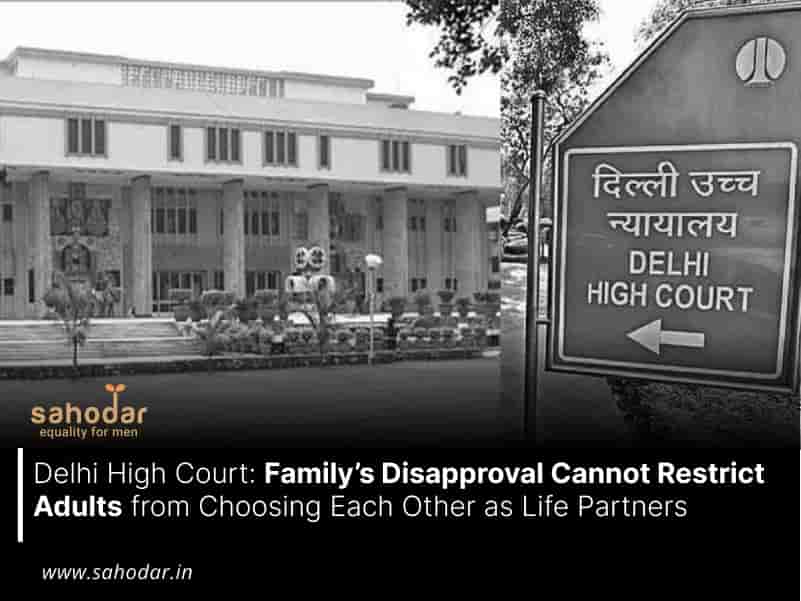
The Court directed Delhi Police to ensure safety of a couple that had eloped and married against family wishes.
The Delhi High Court recently directed the Delhi Police to provide protection to a couple who alleged receiving threats after marrying against the wishes of the woman’s family [Prince Tyagi and Anr. v. State of NCT of Delhi and Ors.].
Justice Sanjeev Narula emphasized that the disapproval of family members cannot override the autonomy of two consenting adults to choose each other as life partners, a right safeguarded under Article 21 of the Constitution of India.
“The right of two consenting adults to choose each other as life partners and to live together in peace is a facet of their personal liberty, privacy, and dignity protected under Article 21. Family disapproval cannot curtail that autonomy. The Supreme Court has repeatedly affirmed this position and directed the police to safeguard such couples from intimidation or harm,” the Court stated.
The couple approached the Court alleging that the woman’s family members had issued life threats through messages, phone calls, and video calls.
Meanwhile, her family had lodged a missing person complaint. During the preliminary inquiry, the police discovered that she had willingly left her parental home to get married.
After hearing the parties, the Court instructed the Delhi Police to provide necessary protection to the couple by assigning beat officers to monitor their safety.
“As regards the Petitioners’ apprehension of threats, Respondent No. 1 (Delhi police/ State of Delhi) shall ensure adequate protection. The SHO of the concerned police station shall designate a beat officer, sensitise him/her to the present order, and furnish to the Petitioners, the mobile numbers of the beat officer and the station’s 24×7 contact. Upon any complaint of threat, the police shall promptly enter a DD entry and extend immediate assistance. For coordination, counsel for the Petitioners shall share the Petitioners’ current place of residence and contact details with the Investigating Officer, today itself,” the Court stated in its August 5 order.