
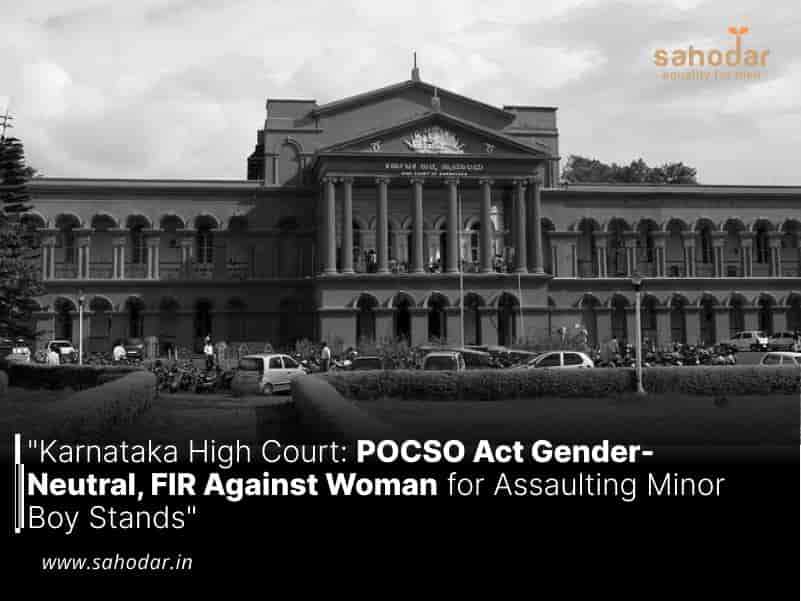
On Monday (August 18), the Karnataka High Court rejected the plea of a 52-year-old woman seeking to quash a sexual assaulting complaint filed by the parents of a minor boy under the POCSO Act, noting that the Act applies to both men and women and is therefore “gender neutral.”
“Justice M Nagaprasanna while pronouncing the order said “POSCO Act being a progressive enactment is intended to safe guard sanctity of childhood it is rooted in gender neutrality with its beneficient object being protection of children, irrespective of sex. The act is thus gender neutral.”
It added, “Section 3 and 5 (POCSO Act), which form the foundation of offences under sections 4 and 6 of the Act delineate various forms of assault, although certain provisions may employ gendered pronouns the preamble and the purpose of the act render such usage inclusive, therefore it is inclusive of both male and female…The ingredients of Section 4 of the Act dealing with penetrative sexual assault are equally applicable to both men and women. The language of provision clearly indicates inclusivity, the ingredients of offences the once punishable under section 4 and 6 are clearly met in the case at hand, albeit prima facie.”
Dismissing the accused’s claim of a four-year delay in filing the case, the court stated, “The delay in the registration of crime cannot become a reason for quashment of proceedings owing to the alleged offence and age of the victim.
The court further observed that the arguments concerning psychological impossibility and the lack of potency testing of the accused do not hold ground in light of modern jurisprudence.
The court also ruled that the claim that a woman is merely a passive participant while a man is the active participant must be “categorically rejected.”
“As the thought itself is archaic, the jurisprudence of present times embraces livid realities of victim and does not allow stereotypes to cloud legal scrutiny,” the court said.
Following which it held “Therefore none of the submissions made by the senior counsel merit acceptance and thus finding no merit the petition stands dismissed.”
Senior Advocate Hashmath Pasha, representing the petitioner, submitted that the complaint under Sections 4 (punishment for penetrative sexual assault) and 6 (punishment for aggravated penetrative sexual assault) of the POCSO Act was filed after a delay of four years. He pointed out that while the alleged offence occurred in 2020, the FIR was lodged only this year.
Pasha further argued that the petitioner was accused of aggravated sexual assault on a 13-year-old schoolboy, who had earlier been her neighbour. He claimed that there were financial transactions between the parties and that the complainant had instituted the case to evade repayment.
The bench in its interim order last year had said, “The case projects a strange circumstance. The petitioner is alleged of the ingredients of Section 4 and 6 of Act against a 13-year-old boy. The petitioner is a lady of 52-years. The incident is said to have happened on May 1, 2020. The complainant is registered on June 26, 2024 after four years. The ld senior counsel would submit that there are a plethora of financial transactions between the parties. Using the child of 13-years of an alleged incident of the 2020 of the petitioner indulging in penetrative sexual assault against a boy, the crime is sought to be registered and police have filed chargesheet”.
In view of the significance the case had attracted, Pasha made an additional submission after the court had reserved its order in June, requesting that the proceedings be held in camera given the nature of the alleged offence, which the court allowed.