
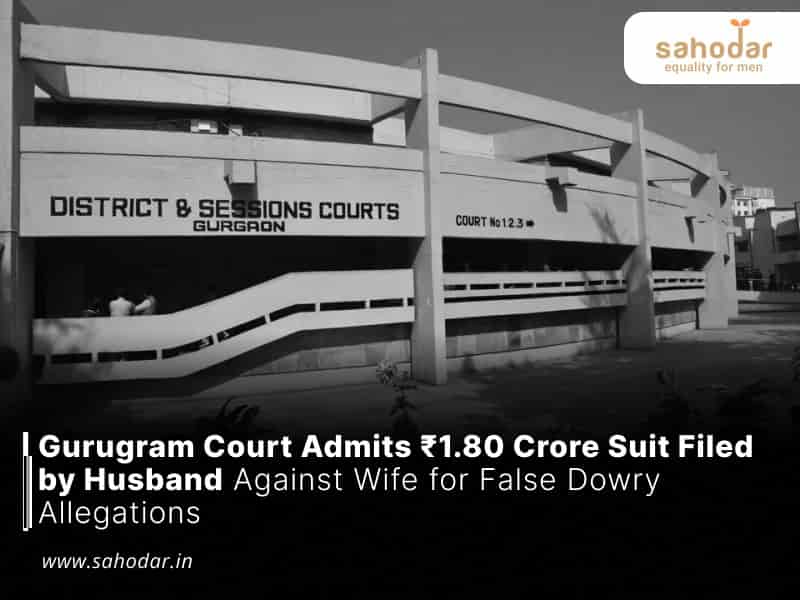
The judgment is seen as a major relief for husbands caught in lengthy legal battles arising from false matrimonial cases.
In a notable ruling, a district court admitted a ₹1.80 crore damages suit filed by a UK-based man against his former wife, who had previously lodged a false dowry case against him. Pronounced on August 13, 2025, by Civil Judge (Senior Division) Manish Kumar, the decision is regarded as a substantial relief for husbands facing prolonged litigation arising from false matrimonial disputes.
The plaintiff, Gurusharam Lal Awasthi, was acquitted of charges under Sections 498A (cruelty), 406 (criminal breach of trust), and 506 (criminal intimidation) of the Indian Penal Code—first by a trial court in 2016, and subsequently by a sessions court in 2018. After his acquittal, Awasthi instituted a civil suit against his former wife for malicious prosecution, alleging financial losses and personal hardship endured during a 16-year-long litigation.
Although Awasthi secured a divorce from a UK court in 2020, neither he nor his wife sought its recognition in India. As per Indian law, foreign divorce decrees are valid only if certain conditions are fulfilled—such as mutual submission to the foreign court’s jurisdiction and the decree being based on grounds permissible under Indian matrimonial law. Absent such recognition, the marriage continues to be legally binding in India.
During the August 13 hearing, the plaintiff’s ex-wife challenged the suit’s maintainability, citing a pending High Court appeal against Awasthi’s acquittal and the non-payment of the prescribed court fee. The court overruled these objections, observing that an acquittal remains valid despite a pending revision and that a tentative court fee is acceptable in actions involving unliquidated damages.
According to Judge Kumar, the plaint revealed a prima facie cause of action for malicious prosecution. He added that the ex-wife’s assertion that the suit was “false and concocted” could be determined only at trial. The court has adjourned the matter to November 20, 2025, for submission of the written statement.
Sharing his experience with HT, Awasthi stated: “The marriage itself lasted just seven days, but I endured 40 days in jail and 16 years of court battles. They demanded ₹1.20 crore to settle, yet I chose to contest. With my passport seized for three years, I was unable to travel or work, and my family bore the brunt of this struggle. My father passed away under constant police harassment. The harm to my dignity and life is simply immeasurable.”
Deepika Narayan Bhardwaj, a women’s rights activist and documentary filmmaker who extended support to Awasthi, praised the court’s ruling. “This judgment is praiseworthy as it brings hope to thousands of men caught in false dowry cases. In spite of the heavy personal, financial, and emotional toll, he pursued his fight. His resilience could set an example for many others to seek redress through malicious prosecution,” she observed.
Legal experts noted that the judgment signifies the judiciary’s recognition of how dowry laws can be misused and is likely to serve as a check on baseless complaints in matrimonial disputes.
Ambika Yadav, a senior lawyer at the Gurugram district court, observed that the order may serve as a significant precedent. “For years, courts were hesitant to admit malicious prosecution claims in matrimonial disputes. By proceeding with this case despite a pending appeal, the court has clarified that acquittal provides a valid ground for damages. It delivers a firm message against misuse of criminal law and could encourage other litigants in comparable circumstances,” she explained.