
Background
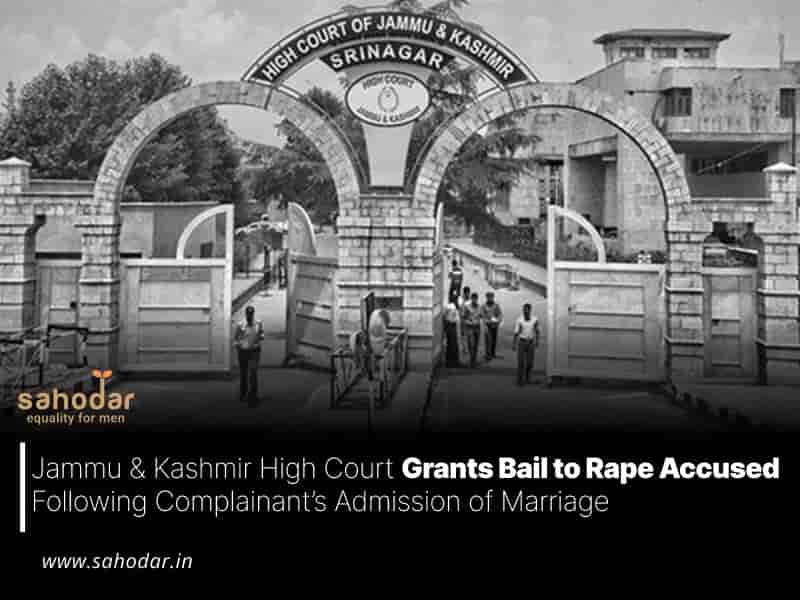
The Jammu & Kashmir High Court grants bail to rape after the complainant acknowledged that she was legally married to him. The case was initially built on allegations that the accused had sexually assaulted the woman under false promises. However, during the proceedings, the complainant informed the court that she and the accused were legally wedded, which significantly impacted the legal interpretation of the case.
The prosecution had charged the accused under Section 376 (rape) of the Indian Penal Code, asserting that the act was committed without valid consent. However, the disclosure of their marital status cast doubt on the validity of the charges, as Indian law typically does not categorize consensual sexual relations within marriage as rape, except in specific circumstances such as marital rape.
Court’s Rationale
While granting bail, the High Court took into account several key factors:
Validity of the Marriage
The complainant’s acknowledgment of her marriage to the accused directly conflicted with the initial rape allegations.
The court noted that marital relationships can be complex, sometimes resulting in disputes being mischaracterized in legal complaints.
Effect on Legal Proceedings
As the rape charge was based on an alleged lack of consent, the acknowledgment of marriage undermined the prosecution’s case.
The court observed that in cases where significant material facts change, keeping the accused in custody would not be justified.
Judicial Precedents on Misleading Allegations
The judgment cited previous cases where courts granted relief when complainants withdrew their allegations or when significant contradictions arose during proceedings.
The court emphasized that criminal law should not be exploited as a means to resolve personal disputes.
Bail as a Fundamental Legal Entitlement
Reinforcing the principle that bail is the norm and jail the exception, the court held that continued detention was unwarranted in light of the complainant’s statement.
It ordered the release of the accused on bail while permitting the legal proceedings to continue as required.
Current Legal Framework and Provisions
Indian Penal Code, 1860
- Section 376 (Rape): Defines the offense of rape and prescribes stringent punishment.
- Marital Rape Exception: Indian law does not consider non-consensual intercourse between spouses as rape unless the wife is under 18 years of age.
Judicial Approach to Bail in Similar Cases
- Courts have granted bail in instances where rape allegations were withdrawn or disproven.
- Cases involving false accusations or misrepresentation of facts have led courts to adopt a cautious approach in criminal proceedings.
Legal Ramifications of the Judgment
Key Implications of the Judgment
- For Criminal Law: Reinforces the principle that allegations must be properly substantiated before subjecting an individual to prolonged detention.
- For Marital Disputes: Highlights the potential misuse of legal provisions in personal conflicts, emphasizing the need for careful judicial examination.
- For Future Cases: Establishes a precedent for courts to reassess charges when complainants alter their statements or disclose new facts.
- For Accused Rights: Strengthens the safeguard that individuals should not be deprived of their liberty when allegations are significantly weakened.
Conclusion
The Jammu & Kashmir High Court’s decision to grant bail in this case emphasizes the significance of factual consistency in legal proceedings. By recognizing the complainant’s admission of marriage, the court upheld the importance of a fair and balanced approach to criminal accusations. This case reflects the evolving judicial stance on intricate marital and legal disputes, ensuring that legal protections are maintained while preventing the misuse of criminal law provisions.