
As per the guidelines, the cases registered under Section 498-A of Indian Penal Code (IPC) are required to be referred to the Family Welfare Committee of the concerned district for settlement of the issues.
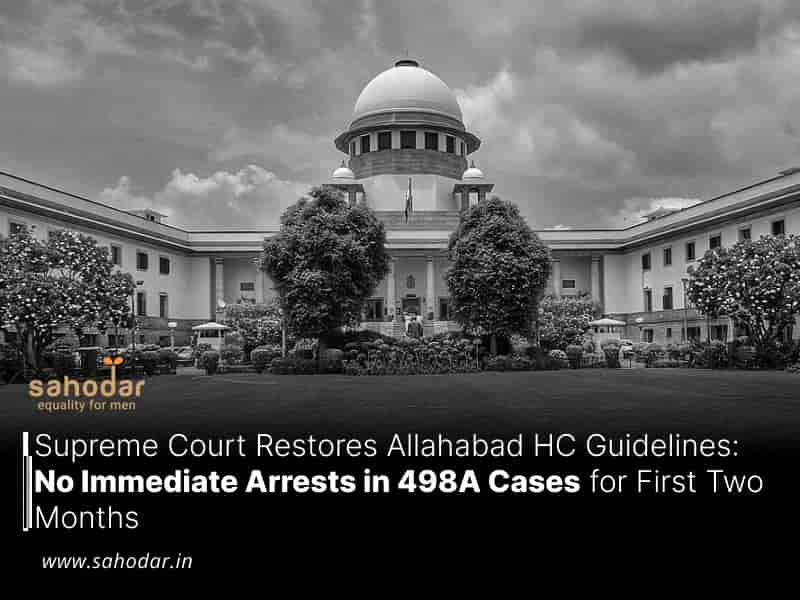
On Tuesday, the Supreme Court directed the nationwide implementation of the Allahabad High Court’s 2022 guidelines, which mandate a two-month “cooling-off” period during which police must refrain from taking any coercive action, including arrests, in matrimonial cruelty cases under Section 498A IPC [Shivangi Bansal v. Sahib Bansal].
According to the guidelines, such cases are to be referred to the concerned district’s Family Welfare Committee (FWC) for potential resolution, with law enforcement barred from initiating any punitive steps during this period.
A Bench comprising Chief Justice of India BR Gavai and Justice Augustine George Masih extended the applicability of these directives throughout the country.
“The guidelines framed by the High Court of Allahabad in the impugned judgment dated 13.06.2022 in Criminal Revision No. 1126 of 2022 vide paras 32 to 38, with regard to ‘Constitution of Family Welfare Committees for safeguards regarding misuse of Section 498A, IPC shall remain in effect and be implemented by the appropriate authorities,” the top court ordered.
The guidelines framed by the Allahabad High Court were originally grounded in the Supreme Court’s 2017 ruling in Rajesh Sharma & Ors. v. State of UP & Anr.
Notably, those directions were later altered and set aside by the Supreme Court in its 2018 judgment in Social Action Forum for Manav Adhikar v. Union of India, effectively rendering Family Welfare Committees (FWCs) non-operational.
However, with the Supreme Court’s latest ruling, the following directives issued by the Allahabad High Court now stand reinstated:
- No arrest or coercive action shall be taken against the named accused following the registration of an FIR or complaint until the completion of a two-month “cooling-off” period. During this period, the matter must be promptly referred to the Family Welfare Committee (FWC) of the concerned district.
- Only such cases shall be referred to the Family Welfare Committee (FWC) “in which Section 498-A IPC along with, no injury 307 and other sections of the IPC in which the imprisonment is less than 10 years.”
- Each district shall have one or more Family Welfare Committees (FWCs), depending on its geographical area and population, constituted under the District Legal Services Authority (DLSA) and comprising a minimum of three members. The composition and functioning of these committees shall be periodically reviewed by the District & Sessions Judge or the Principal Judge of the Family Court, who will serve as the Chairperson or Co-chairperson of the DLSA.The Family Welfare Committee shall consist of the following members:
(a) a young mediator from the district’s Mediation Centre, a young advocate with up to five years of practice, or a final-year law student from a Government Law College, State University, or NLU with a strong academic record and a commitment to public service;
(b) a well-known and respected social worker from the district with a clean background;
(c) retired judicial officers residing in or near the district who are willing to dedicate time to the committee’s objectives; or
(d) educated spouses of senior judicial or administrative officers of the district. - Every complaint or application filed under Section 498A IPC and related provisions must be promptly forwarded to the Family Welfare Committee by the concerned Magistrate. Upon receipt of the complaint or FIR, the FWC shall summon the disputing parties along with four senior or elderly family members from both sides for a personal interaction, with the aim of resolving the issues or misunderstandings between them within a two-month period from the date of filing.
- The report submitted by the Family Welfare Committee shall be considered by the investigating officer or the Magistrate on its own merits. Based on this assessment, appropriate action shall be taken in accordance with the provisions of the Code of Criminal Procedure, but only after the completion of the two-month “cooling-off” period.
7. In the event of a settlement between the parties, the District & Sessions Judge, along with other senior judicial officers designated by him within the district, shall have the discretion to conclude the proceedings, including the closure of the criminal case.The Supreme Court issued the directive while hearing a matrimonial dispute where both spouses had filed multiple cases against each other. In connection with the complaints lodged by the wife, the husband was incarcerated for 109 days, and his father for 103 days.
In an unusual move, the apex court directed the wife and her family to publish an unconditional apology in a newspaper, acknowledging the trauma and harassment caused to the husband and his family.
“Such apology shall also be published and circulated on all social media platforms like Facebook, Instagram, YouTube and other similar platforms. The expression of apology herein shall not be construed as an admission of liability and shall have no bearing on the legal rights, obligations, or consequences arising under law,” the Court ordered.
Considering the directions and settlement between the parties, the Court quashed the criminal cases and also dissolved the couple’s marriage, while invoking its powers under Article 142 of the Constitution of India.