
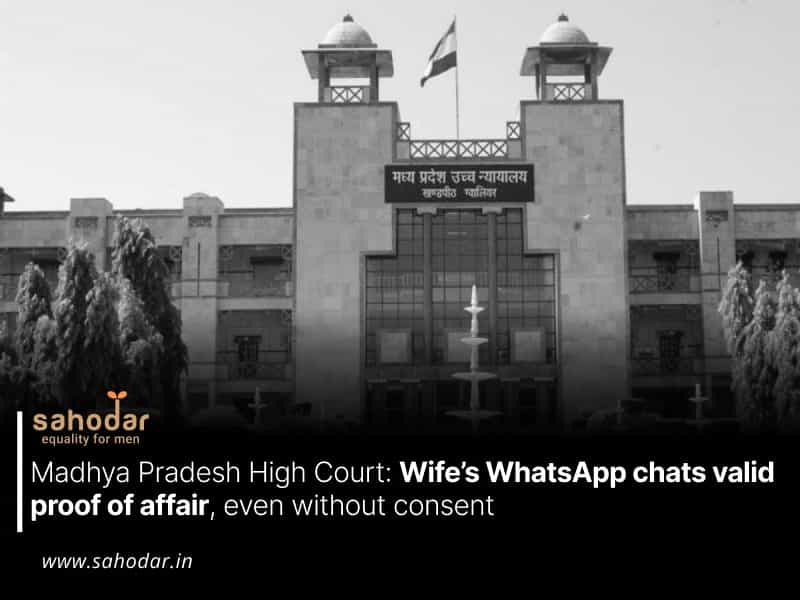
The High Court held that a husband can use his wife’s WhatsApp chats, even if obtained without her consent, as evidence in a divorce case to prove adultery. It clarified that the right to privacy is not absolute and may yield to the right to a fair trial. However, the final decision on admitting such evidence rests with the family court.
On June 16, 2025, the Madhya Pradesh High Court ruled that a wife’s private WhatsApp chats can be submitted as evidence under Section 14 of the Family Courts Act, 1984, even if accessed without her consent. For context, Section 14 empowers Family Courts to accept any material that may assist in resolving matters like divorce, even if such evidence isn’t ordinarily admissible under the Indian Evidence Act, 1872.
In this case, the husband used a special app secretly installed on his wife’s phone to access her private WhatsApp chats, which revealed her extramarital affair. His legal team submitted the chats as evidence in court, seeking divorce on the grounds of cruelty and adultery. The wife’s lawyers opposed the move, arguing that presenting the chats violated her right to privacy under Article 21 of the Constitution and provisions of the Information Technology Act—specifically Sections 43, 66, and 72.
However, the Madhya Pradesh High Court dismissed these objections, stating that while the right to privacy is a fundamental right, it is not absolute and is subject to reasonable restrictions and exceptions.
The High Court referred to multiple Supreme Court rulings that supported its interpretation of Article 21. It further clarified that the judgment stands even if the WhatsApp chats are not admissible under the Indian Evidence Act, 1872.
The Madhya Pradesh High Court ruled in the husband’s favour, focusing specifically on the interpretation of the Indian Evidence Act, Article 21, and the Family Courts Act. However, it did not rule on the authenticity of the WhatsApp chats, leaving that determination to the family court. If the family court finds the chats admissible and authentic, the husband may be granted divorce on grounds of cruelty and adultery.
Read on to understand why the wife’s argument was rejected and the key Supreme Court precedent the High Court relied on in reaching its decision.
How did this divorce dispute start?
As per the Madhya Pradesh High Court’s order dated June 17, 2025, the timeline of events is as follows:
December 1, 2016: The couple got married in Gwalior, Madhya Pradesh, in accordance with Hindu rites and rituals.
October 11, 2017: The couple was blessed with a daughter.
2018: The husband filed a divorce petition under Section 13 of the Hindu Marriage Act, 1955, citing cruelty. He also alleged adultery on the wife’s part and specifically referred to her WhatsApp chats with a third person as evidence.
He claimed that a special application installed on his wife’s phone automatically forwarded her WhatsApp messages to his device, revealing her extramarital relationship with another man.
April 13, 2024: The Gwalior Family Court allowed the husband to present the wife’s WhatsApp chats as evidence to support his allegation of adultery.
Challenging this decision, the wife filed an appeal before the Madhya Pradesh High Court.
Before the Madhya Pradesh High Court, the wife argued that her right to privacy had been violated and cited Sections 43, 66, and 72 of the Information Technology Act.
Her lawyers contended that the husband’s act of secretly installing an application on her phone without her consent was illegal and infringed upon her fundamental right to privacy. They maintained that since the evidence was obtained through unlawful means, it should be deemed inadmissible and the husband should not be permitted to rely on it in court.
What did Madhya Pradesh High Court say?
The Madhya Pradesh High Court examined several Supreme Court judgments, along with the provisions of the Evidence Act and the Family Courts Act, and observed:
- Citing the Supreme Court’s rulings in Shardaand Puttaswamy, the Court affirmed that while the right to privacy is indeed a fundamental right under Article 21 of the Constitution, it is not absolute.
- In situations of necessity, laws may permit limited intrusions into personal liberty. Provisions like Section 14 of the Family Courts Act and Section 122 of the Indian Evidence Act are examples of such statutory exceptions that allow for a breach of privacy. Notably, since the constitutional validity of these provisions has not been challenged, they are presumed to be fair, reasonable, and legally valid.
- Since no fundamental right under the Constitution is absolute, a conflict between two such rights—like in this case, the right to privacy versus the right to a fair trial, both rooted in Article 21—must be resolved by balancing their importance. In such scenarios, the right to privacy may have to give way to the right to a fair trial.
- While every litigant is entitled to privacy, that right cannot override the opposing party’s right to present evidence deemed relevant to their case. A fair trial fundamentally requires that both parties be given an equal opportunity to bring forward material evidence.
- It’s also essential to recognize that the right to privacy is an individual right, whereas the right to a fair trial has broader implications for the justice system and public interest—making it a more compelling concern in such conflicts.
- The cause of public justice would be compromised if a fair trial is denied by blocking evidence a party seeks to present right from the outset. To hold otherwise would undermine the specific intent of Section 14 of the Family Courts Act, which explicitly allows the admissibility of evidence regardless of whether it meets the standards set by the Indian Evidence Act.
Madhya Pradesh High Court final judgement
As per the Madhya Pradesh High Court’s order dated June 16, 2025, the following are the key details:
- The Court is of the view that the Legislature, fully cognizant of the principles governing admissibility of evidence, deliberately enacted Section 14 to broaden those principles specifically for matters involving marriage and family disputes.● Section 14 liberates the Family Court from the rigid constraints of formal evidence laws. The sole criterion for admitting evidence—regardless of how it was obtained—is the court’s subjective satisfaction that such evidence will help in effectively resolving the dispute.
- Moreover, once the evidence is placed on record, the Family Court has the discretion to accept it, reject it, or assign it appropriate weight while making its final decision on the matter.● In other words, simply admitting evidence under Section 14 does not obligate the Family Court to rely on it. If the evidence is found to be untrustworthy during evaluation, the court is free to disregard it at the time of final adjudication.
- The opposing party also has the right to challenge, cross-examine, and refute the cited evidence, as well as contest any claims based on it.● Section 14 provides a limited relaxation by allowing the Family Court to admit reports, statements, documents, or other materials into evidence—even if they wouldn’t be admissible under traditional evidence rules—if the court believes they would aid in effectively resolving the dispute.
● The value or weight assigned to such evidence is entirely at the judge’s discretion during the final adjudication of the dispute.
The High Court said:
Evidence remains admissible as long as it is relevant, regardless of the manner in which it was obtained.
Simply admitting evidence into the record does not establish the truth of a fact-in-issue or a relevant fact.
The test of ‘relevance’ safeguards a party’s right to present evidence in court, thereby upholding the right to a fair trial. However, the mere admission of such evidence does not exempt the person who obtained it unlawfully from any potential civil or criminal liability.
Such evidence should be admitted and evaluated with care and caution, ensuring that any possibility of tampering is thoroughly ruled out.
What do the experts say about it?
Ruchita Datta, Partner at D&T JURIS, states: “In my view, if the evidence presented by the husband to establish his wife’s alleged adultery is found to be relevant, authentic, and credible by the Family Court, it can significantly aid the court in reaching a fair and prompt decision. Therefore, the method used to obtain the evidence will not pose an obstacle, provided the party presenting it fulfills the essential criteria laid down by the court.”
Datta further emphasizes that electronic evidence—such as chats and emails—must be supported by a certificate under Section 63 of the Bharatiya Sakshya Adhiniyam, 2023. This certificate must be issued by the ‘person in charge of the device or system’ from which the chats are produced, attesting to their authenticity, reliability, and protection from tampering.
Datta explains: “To present electronic evidence, the party submitting it must be able to demonstrate its authenticity and integrity. Direct evidence such as chats or social media photos—when relevant to the case—can be highly effective in proving adultery, which is otherwise often established through circumstantial evidence and witness testimony. Even if access to such chats was unauthorized, it can still form the basis for seeking court permission to issue interrogatories or obtain formal orders for the other party to legally produce the device and chats before the court.”
Aditya Chopra, Managing Partner at The Victoriam Legalis (TVL), adds that this judgment marks a significant development in family law jurisprudence in India, offering key legal insights.
Chopra further says:
Firstly, it reinforces that Section 14 of the Family Courts Act, 1984 allows the admission of any relevant evidence—including electronic records such as WhatsApp chats—regardless of how they were obtained, thus easing the rigid requirements of the Indian Evidence Act, 1872.
Secondly, it affirms that the fundamental right to privacy under Article 21 is not absolute and must give way to the right to a fair trial in matrimonial cases, highlighting the greater public interest in the effective delivery of justice.
The judgment further clarifies that admissibility is determined by relevance; however, courts must exercise careful judicial discretion, thoroughly scrutinizing the evidence for authenticity and reliability during adjudication.
It also underscores that Family Courts have the discretion to evaluate or disregard evidence based on its probative value.
Finally, it acknowledges that individuals affected by the unlawful collection of evidence may seek civil or criminal remedies—but this does not automatically render the evidence inadmissible in Family Court, thereby striking a balance between protecting individual rights and ensuring judicial efficiency.
Sonam Chandwani, Managing Partner at KS Legal, remarks: “This judgment is a bold yet controversial affirmation of the Family Courts Act’s intent to prioritize efficient dispute resolution. By allowing the admissibility of WhatsApp chats under Section 14—even when obtained without consent—it places the right to a fair trial above the fundamental right to privacy under Article 21. While the Court’s reliance on Section 122 of the Evidence Act and its clarification of prior sub silentio rulings strengthens the legal framework, its acceptance of potentially unlawful methods of evidence collection, such as unauthorized phone monitoring, raises serious concerns. This could inadvertently legitimize invasive practices in emotionally charged matrimonial cases.
Although safeguards like in-camera proceedings and stringent authenticity checks are commendable, they are largely reactive and do not adequately prevent privacy violations. In my opinion, while the ruling may enhance judicial efficiency, it highlights the urgent need for legislative clarity on digital evidence—so that justice is pursued without compromising personal autonomy in an era of growing technological surveillance.”
Kirti Vyas, Associate, ASL Partners, says:
The first major takeaway is that evidence gathered without consent—including private digital communications—is not automatically inadmissible in Family Courts, as long as it is relevant to the matter in dispute. Section 14 of the Family Courts Act authorizes the court to accept such material, even if it wouldn’t be admissible under the Indian Evidence Act, as long as the court believes it will aid in resolving the case.
Secondly, the Court clarified that the admission of such evidence does not guarantee it will be relied upon. The Family Court has complete discretion to evaluate its authenticity, reliability, and evidentiary value during final adjudication. Therefore, simply submitting material to the record does not equate to establishing a fact in issue.
Thirdly, although the Court allowed the exhibition of such evidence, it clearly stated that doing so does not shield the party who acquired it unlawfully from potential civil or criminal liability. Any grievances regarding the illegal collection of evidence must be addressed through separate legal proceedings, not by excluding potentially relevant material from consideration by the Family Court.
Fourthly, the Court expressly rejected earlier rulings that overlooked the applicability of Section 14 of the Family Courts Act and Section 122 of the Indian Evidence Act, declaring those decisions to be made sub silentio and per incuriam—without proper consideration of the relevant legal provisions.
Finally, the Court underscored the importance of judicial safeguards when exercising the broad powers granted under Section 14. It emphasized that such evidence should undergo thorough scrutiny to verify its authenticity, proceedings should be held in-camera when necessary, and courts must remain vigilant to prevent the misuse of private information or turning the matter into a public spectacle.
Kunal Maliramani, Associate at Accord Juris, remarks: “This judgment reinforces the broad discretionary powers that Family Courts hold under Section 14 of the Family Courts Act, 1984 regarding admissibility of evidence. It also reiterates that while the right to privacy is a fundamental right, it cannot supersede the right to a fair trial. Importantly, the ruling clarifies that admissibility does not equate to automatic reliance—the evidence must still withstand judicial scrutiny.
The Court’s emphasis on safeguards, such as in-camera proceedings, reflects a thoughtful balance between privacy and justice. Additionally, it notably applies the doctrines of per incuriam (decisions made through oversight) and sub silentio (decisions made without addressing a key point) to dismiss earlier High Court rulings that failed to consider the Family Courts Act and Section 122 of the Evidence Act. Crucially, the judgment also affirms that while such evidence may be admitted, the party who obtained it unlawfully may still be subject to civil or criminal liability.”
Maliramani explains: “This judgment provides clarity on the interpretation of Sections 14 and 20 of the Family Courts Act, 1984, reinforcing that in matrimonial disputes, the relevance of evidence takes precedence. Permitting evidence that may otherwise be inadmissible aligns with the Act’s core objective.
The Court rightly acknowledges that Family Courts must prioritise the right to a fair trial over procedural hurdles such as privacy objections. By allowing WhatsApp chats—even if obtained through questionable means—it sets a practical precedent for the admissibility of electronic evidence in family matters. The judgment reflects the need for procedural flexibility in emotionally sensitive cases, such as those involving allegations of adultery. It carefully balances the principles of justice by focusing on fair and effective adjudication while still recognising the complexities of personal relationships.”