
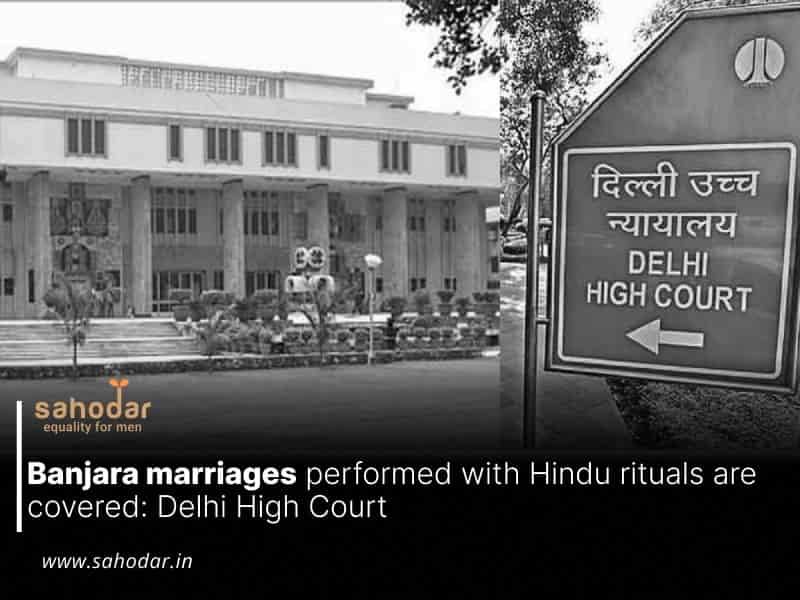
The Court said that the Banjara community, a scheduled tribe, has become substantially ‘Hinduised’.
The Delhi High Court recently held that the Banjara community, though classified as a Scheduled Tribe, has undergone significant ‘Hinduisation’, and marriages among its members solemnized with Hindu rituals are governed by the Hindu Marriage Act (HMA).
A Division Bench comprising Justices Anil Kshetarpal and Harish Vaidyanathan Shankar dismissed the husband’s objection that a divorce petition under the HMA was not maintainable on the ground that the parties belonged to a Scheduled Tribe.
Accordingly, the High Court affirmed the family court’s decision holding that a divorce petition filed by a Banjara (Lambada) woman under the Hindu Marriage Act was maintainable.
Referring to expert writings and ethnographic studies cited by the petitioner, the Court observed that while the Banjara community has traditionally been recognized as a Scheduled Tribe, it has gradually undergone a process of Hinduisation. The Bench noted that the community’s matrimonial practices now incorporate significant Hindu rituals, resulting in a blended system reflecting both Lambada and Hindu traditions.
“In this view, and with respect to the present case, the performance of essential Hindu ceremonies, which include the invocation of the sacred fire, the wearing of Mangalsutra and Bichiya, and the Saptapadi, clearly reflects that the marriage bore all the hallmarks of a Hindu sacrament. The contention of the Appellant that the parties were not Hinduised is, therefore, untenable. It is evident that the Appellant has not substantially shown or deposed that the marriage was performed according to the customs of the Lambada community, neither in the affidavit nor in the cross-examination,” the Court said.
The case before the High Court arose from a petition filed by the husband challenging the family court’s decision to dismiss his objection to the divorce proceedings.
He contended that the divorce petition was not maintainable under Section 2(2) of the Hindu Marriage Act, which excludes its application to members of Scheduled Tribes unless specifically extended by a Central Government notification.
Aggrieved by the family court’s ruling, the husband approached the High Court seeking to set aside the order.
After examining the matter, the High Court concurred with the findings of the family court.
The Bench observed that Section 7 of the Hindu Marriage Act does not mandate any specific form of ceremony for a valid marriage but instead acknowledges the wide range of matrimonial customs practiced within Hindu communities.
It further noted that under Section 7, a Hindu marriage is deemed valid upon the performance of customary rites and ceremonies, a mutual intention to enter into matrimony, the observance of saptapadi where applicable, and proof of solemnisation. The Court added that the Banjara community has incorporated the essential elements of Hindu marriage rituals into its own customs.
“In this view, the determination in the present case as to whether the marriage between the parties satisfies the essentials prescribed under Section 7 of the Hindu Marriage Act, 1955, hinges upon the evidence adduced to establish that the ceremonies performed were those recognized either under Hindu law or under the customary practices of the Lambada (Banjara) community, which, as demonstrated, have assimilated essential elements of Hindu solemnization,” the Court underlined.
Accordingly, the Court dismissed the husband’s appeal.
“On a holistic reading of the evidence, the pleadings, and the findings recorded by the Learned Family Court, this Court finds no infirmity in the conclusion that the marriage in question was performed in accordance with Hindu rites and customs and is, therefore, governed by the HMA,” it concluded.