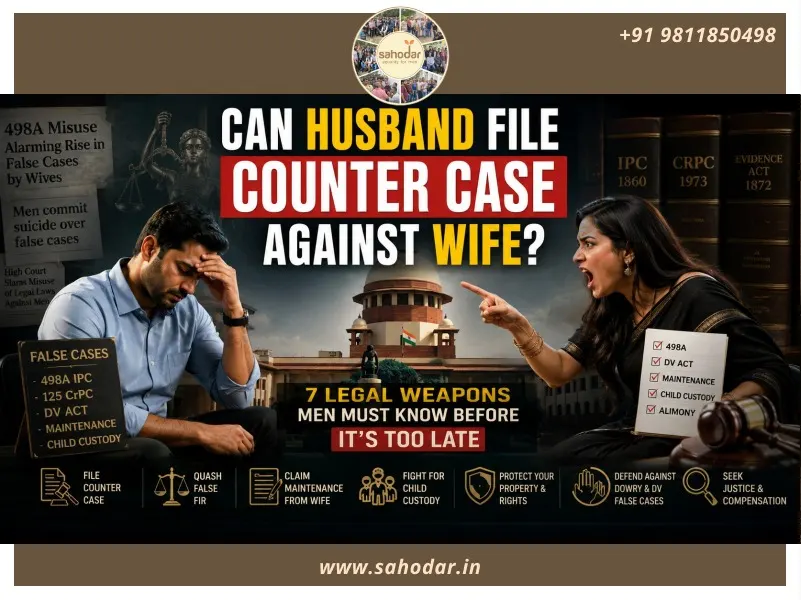
A practical legal guide for husbands facing false cases, extortion, mental cruelty and litigation abuse
NEW DELHI: Most men enter marriage believing that even if things go wrong emotionally, the law will remain neutral. But for thousands of husbands across India, matrimonial disputes quickly turn into police complaints, court cases, financial pressure, social humiliation and years of mental stress.
Many men feel trapped because society often assumes the husband must automatically be at fault. What is rarely discussed openly is that Indian law does provide remedies against false allegations, malicious prosecution, mental cruelty and abuse of legal process.
A husband is not legally helpless.
Courts, including the Supreme Court, have repeatedly acknowledged that false matrimonial allegations can destroy a man’s reputation, career, finances and mental health.
The real problem is that most men simply do not know what legal remedies actually exist.
Depending on the facts of the case, a husband may file counter proceedings involving defamation, divorce on grounds of cruelty, perjury, malicious prosecution, custody claims or even quashing of false FIRs before the High Court.
Here are 7 important legal remedies every husband should understand before matrimonial litigation spirals completely out of control.
Defamation Case Against Wife
When False Allegations Destroy Reputation
One of the most damaging aspects of matrimonial litigation is reputational destruction. Allegations made during marital disputes often spread beyond the courtroom and reach relatives, employers, social media platforms and society at large.
False accusations involving dowry harassment, domestic violence, impotence, abuse or infidelity can permanently damage a man’s personal and professional life.
In such situations, a husband may consider initiating criminal or civil defamation proceedings.
Relevant Legal Provisions
- Section 356, Bharatiya Nyaya Sanhita (Defamation)
- Civil Suit For Damages
A husband may file a criminal complaint for defamation if false statements were intentionally circulated to harm his reputation.
In serious cases involving financial or professional damage, a civil defamation suit seeking monetary compensation may also be filed.
Situations Where Defamation May Arise
- False social media allegations
- Public accusations without proof
- Complaints sent to employer or workplace
- False criminal accusations later found baseless
- Public humiliation through fabricated allegations
The Supreme Court in Subramanian Swamy v. Union of India upheld the constitutional validity of criminal defamation and recognised reputation as an important aspect of dignity.
Similarly, in K. Srinivas Rao v. D.A. Deepa, the Supreme Court observed that false complaints and reckless allegations by a spouse may amount to mental cruelty.
Perjury Proceedings Against False Statements
Lying In Court Is Also A Criminal Offence
Many matrimonial disputes involve false affidavits, manipulated income disclosures, fabricated allegations or contradictory statements made before different courts.
Very few people realise that knowingly giving false evidence before a court can itself become a criminal offence.
Relevant Legal Provisions
- Sections 227–229 Bharatiya Nyaya Sanhita
- Section 340 CrPC proceedings
Perjury proceedings are generally initiated when a party deliberately lies under oath or files false documents before a judicial authority.
Common Examples
- False income disclosures
- Fake domestic violence narratives
- Concealing employment or assets
- Contradictory statements in multiple cases
- Filing false affidavits
The Supreme Court in Murray & Co. v. Ashok Kr. Newatia emphasised that false evidence and misleading courts strike at the foundation of the justice system.
However, courts exercise caution before initiating perjury proceedings.
Minor inconsistencies are usually insufficient. The falsehood must generally be deliberate, material and supported by clear evidence.
Divorce On Ground Of Mental Cruelty
False Cases Themselves Can Become Grounds For Divorce
One of the strongest legal remedies available to husbands is divorce on the grounds of mental cruelty.
Indian courts have repeatedly recognised that false criminal allegations, repeated humiliation and malicious litigation can amount to cruelty under matrimonial law.
Relevant Legal Provision
- Section 13(1)(ia), Hindu Marriage Act
What Courts Commonly Treat As Mental Cruelty
- False 498A complaints
- Threats of arrest
- Public humiliation
- Character assassination
- Repeated police complaints
- Harassment of elderly parents
- Continuous litigation abuse
In Samar Ghosh v. Jaya Ghosh, the Supreme Court laid down broad principles explaining what may constitute mental cruelty in matrimonial disputes.
In K. Srinivas Rao v. D.A. Deepa, the Court specifically held that false criminal complaints filed by one spouse against another can amount to mental cruelty.
Similarly, in Naveen Kohli v. Neelu Kohli, prolonged matrimonial litigation and hostile conduct were recognised as destructive to marital life.
Courts increasingly recognise that psychological harassment can be as damaging as physical cruelty.
Case For False 498A Or Malicious Prosecution
What Happens When Criminal Law Is Used As A Weapon?
False implication in dowry harassment cases often affects not just the husband, but also elderly parents, sisters, relatives and even distant family members.
Where allegations are demonstrably false and malicious, a husband may explore legal remedies for malicious prosecution or false criminal accusations.
Relevant Legal Provisions
- Section 248 Bharatiya Nyaya Sanhita
- Section 250 CrPC
- Civil claim for malicious prosecution
Situations Commonly Seen
- Entire family named without specific allegations
- Arrest threats used for settlement pressure
- False medical allegations
- Deliberate exaggeration of incidents
- Criminal complaints filed immediately after financial disputes
The Supreme Court in Arnesh Kumar v. State of Bihar warned against automatic arrests in 498A cases and issued important safeguards against misuse.
Similarly, in Rajesh Sharma v. State of U.P., the Court acknowledged concerns regarding misuse of matrimonial criminal litigation.
However, husbands must understand one important legal reality:
Acquittal alone does not automatically prove that a case was false or malicious. Courts generally require proof of intentional misuse or fabricated allegations.
Restitution Of Conjugal Rights (RCR)
When Wife Leaves Matrimonial Home Without Valid Reason
In some matrimonial disputes, the wife leaves the matrimonial home without sufficient legal justification while simultaneously initiating maintenance or criminal proceedings.
In such situations, a husband may consider filing a petition for Restitution of Conjugal Rights.
Relevant Legal Provision
- Section 9, Hindu Marriage Act
An RCR petition essentially asks the court to direct the spouse to resume cohabitation.
Why RCR Matters Strategically
- Shows willingness to continue marriage
- Can impact maintenance proceedings
- Helps establish husband’s conduct before court
- Demonstrates absence of desertion from husband’s side
The constitutional validity of RCR was upheld by the Supreme Court in Saroj Rani v. Sudarshan Kumar Chadha.
That said, modern courts increasingly examine matrimonial realities carefully before granting such relief.
RCR should never be filed mechanically. It should form part of a broader legal strategy based on actual facts.
Custody & Guardianship Proceedings
Fathers Also Have Rights Over Their Children
One of the most emotionally devastating aspects of matrimonial conflict is separation of fathers from their children.
Many fathers struggle with denied visitation, parental alienation or false allegations used during custody litigation.
Indian law does recognise the rights of fathers.
Relevant Laws
- Guardians and Wards Act, 1890
- Hindu Minority and Guardianship Act, 1956
Important Issues In Custody Litigation
- Denial of visitation
- Emotional alienation of child
- Relocation disputes
- False abuse allegations
- Access restrictions
The Supreme Court in Gaurav Nagpal v. Sumedha Nagpal held that the welfare of the child remains the paramount consideration in custody disputes.
In Yashita Sahu v. State of Rajasthan, the Court emphasised that children should not lose the love and affection of either parent.
Modern courts increasingly support:
- Interim visitation
- Shared parenting concepts
- Video call access
- Holiday custody arrangements
Fathers should approach custody battles strategically and avoid emotionally reactive conduct during litigation.
Quashing Of False FIR Through High Court
High Courts Can Stop Abuse Of Criminal Law
One of the strongest legal remedies available against false matrimonial FIRs is approaching the High Court for quashing proceedings.
Relevant Legal Provision
- Section 528 Bharatiya Nagarik Suraksha Sanhita (Earlier Section 482 CrPC)
The High Court has inherent powers to prevent abuse of legal process and secure the ends of justice.
Situations Where Quashing May Be Considered
- No prima facie offence disclosed
- Omnibus allegations without specifics
- Distant relatives unnecessarily implicated
- Settlement reached between parties
- Purely matrimonial dispute converted into criminal litigation
The landmark judgment in State of Haryana v. Bhajan Lal laid down important principles governing quashing of criminal proceedings.
In Preeti Gupta v. State of Jharkhand, the Supreme Court expressed concern over exaggerated allegations in matrimonial disputes and unnecessary implication of family members.
Quashing petitions require careful drafting, documentary support and strong legal strategy.
Important Evidence Every Husband Should Preserve
The outcome of matrimonial litigation often depends more on evidence than emotions.
Men facing matrimonial disputes should immediately preserve:
- WhatsApp chats
- Emails
- Call recordings where legally permissible
- Bank statements
- Marriage photographs/videos
- CCTV footage
- Medical records
- Settlement discussions
- Audio threats
- Social media posts
- Court documents and orders
Poor documentation is one of the biggest reasons many men struggle during matrimonial litigation.
Common Mistakes Husbands Should Avoid
Many men damage their own cases through emotional reactions or poor legal decisions.
Common Mistakes Include
- Posting emotional content online
- Sending threatening messages
- Ignoring court summons
- Stopping maintenance without court orders
- Filing weak counterblast complaints
- Depending only on verbal settlements
- Sharing confidential legal strategy publicly
Every legal action should be evidence-based and strategically planned.
CONCLUSION
Matrimonial litigation in India is no longer limited to divorce alone. For many men, it becomes a prolonged battle involving criminal allegations, financial pressure, emotional trauma, reputational damage and separation from children.
But husbands are not without legal remedies.
Indian courts have repeatedly recognised that false allegations, malicious prosecution and litigation abuse can destroy lives. Depending on the facts of the case, husbands may pursue remedies ranging from defamation and perjury proceedings to divorce, custody claims, FIR quashing and malicious prosecution actions.
The key is not emotional retaliation — but strategic legal action backed by evidence, patience and proper legal guidance.
Because once matrimonial litigation begins, delay and ignorance often become the biggest weapons used against men.
FAQs
- Can A Husband File A Case Against His Wife For False Allegations?
Yes. Depending on the facts, a husband may file cases relating to defamation, perjury, malicious prosecution, mental cruelty, child custody or seek quashing of false FIRs before the High Court. - Can False 498A Or Domestic Violence Cases Become Grounds For Divorce?
Yes. Indian courts have repeatedly held that false criminal allegations and continuous litigation harassment may amount to mental cruelty under matrimonial law. - Can A Husband Take Legal Action If His Entire Family Is Falsely Implicated?
Yes. If relatives are unnecessarily named without specific allegations, remedies such as FIR quashing, discharge applications and malicious prosecution proceedings may be explored. - Can A Husband Get A False FIR Quashed By The High Court?
Yes. High Courts have powers under Section 528 BNSS (earlier Section 482 CrPC) to quash criminal proceedings where allegations are vague, malicious or do not disclose any prima facie offence. - What Evidence Should A Husband Preserve During Matrimonial Disputes?
A husband should preserve WhatsApp chats, emails, bank records, call recordings where legally permissible, medical documents, social media posts, CCTV footage and all court-related documents.