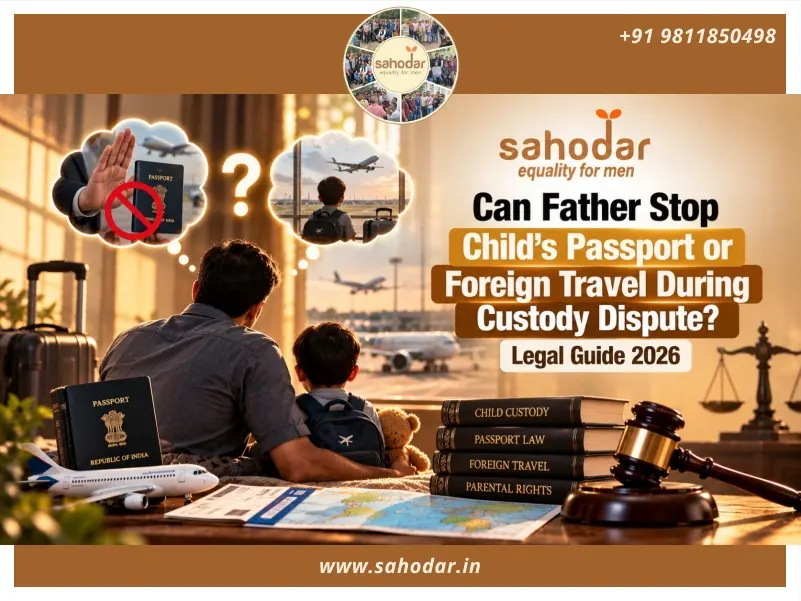
Can a Mother Take a Child Abroad Without the Father’s Consent? Know the Passport Rules, Supreme Court Judgments, Custody Rights and Legal Remedies Available to Fathers in India.
NEW DELHI: A child’s passport should never become a weapon in a custody battle, nor should foreign travel become a means of separating a father from his child. Yet, in many matrimonial disputes, fathers face the possibility of their children being taken abroad without their consent, potentially jeopardising their custody and visitation rights.
Under Indian passport and child custody laws, a mother may obtain a minor’s passport without the father’s consent in certain circumstances. However, passport issuance does not automatically override custody orders or give unrestricted permission to relocate a child abroad.
Read Also:- Myths about child custody in India
A father cannot stop passport issuance merely by refusing to sign an NOC, but he can seek court intervention to restrict foreign travel where there are genuine concerns about the child’s welfare, permanent relocation or denial of visitation rights.
Recent Supreme Court and High Court judgments in 2026 clarify the legal position, the circumstances in which a father can challenge foreign travel and the remedies available to protect his parental rights.
CAN A FATHER REFUSE CONSENT FOR HIS CHILD’S PASSPORT?
Under the Passports Act, 1967, and the Passports Rules, 1980, passport applications for minors ordinarily require parental declarations.
However, the father’s signature is not always a legal requirement.
The Ministry of External Affairs provides a specific procedure through Annexure C, allowing one parent to apply for a minor’s passport when the other parent’s consent is unavailable or withheld, subject to prescribed conditions.
The official Passport Seva guidelines recognise situations involving separated parents, divorce proceedings, exclusive custody, and the other parent’s non-cooperation.
What does Annexure C actually permit?
The current declaration covers several circumstances, including:
- Pending divorce or custody litigation where no court order prohibits passport issuance.
- A parent deliberately withholding consent.
- One parent having exclusive custody under a court order.
- A parent being unavailable, having abandoned the child or living abroad.
Supporting documents depend on the circumstances. If a court has expressly restricted passport issuance, you must obtain the required consent or judicial permission.
The father can raise legitimate objections, but refusing to sign a No Objection Certificate (NOC) does not automatically stop the passport authority from processing the application.
Importantly, an Annexure C declaration must be truthful. Misleading declarations can invite passport cancellation and other legal consequences.
CAN A FATHER STOP HIS CHILD FROM TRAVELLING ABROAD?
Yes, through an appropriate court order, but not merely because he is the father.
A father who fears his child may be permanently relocated abroad can apply to the competent Family Court or guardianship court for urgent protective directions.
Courts may consider restricting foreign travel where credible evidence indicates that:
- The proposed relocation would frustrate existing custody or visitation orders.
- The travelling parent may not return the child to India.
- There is a genuine risk of parental abduction or concealment.
- The child’s education, stability or relationship with the other parent would be seriously affected.
A parent cannot simply demand an international travel ban because the marriage has broken down.
The decisive legal consideration is the child’s welfare, not either parent’s convenience or unilateral preference.
Equally important, not every foreign holiday or overseas educational opportunity requires fresh court permission. The requirement depends on existing orders, applicable guardianship provisions and the circumstances of the dispute.
WHAT THE SUPREME COURT AND HIGH COURTS RULED IN 2026
- Supreme Court: father’s visitation rights must be protected even when foreign travel is allowed
Case: Vishal Verma v. Twinkle Vinayak SLP(C) No. 5943/2026
This case directly addresses a father’s concern that foreign relocation could destroy his relationship with his child.
The father had been granted regular visitation and overnight custody. The mother later took their son to the United States without prior court permission or informing the father.
After litigation, the Delhi High Court permitted the mother to travel to the United States with their son for postgraduate studies, subject to safeguards.
The father challenged those arrangements before the Supreme Court.
What happened before the Supreme Court?
The father’s side argued that prolonged overseas residence would undermine the bond strengthened through court-ordered visitation. The mother maintained that she had a right to pursue higher education and that the child had remained in her custody.
The Supreme Court allowed the mother to continue her overseas education with the child but strengthened the father’s access.
It directed that the child spend at least one month of summer vacation and approximately 10–15 days of winter vacation with the father, depending on the vacation’s duration, along with existing communication and disclosure safeguards.
Legal significance: Foreign relocation can be permitted, but courts must meaningfully protect the non-custodial parent’s relationship with the child.
- Delhi High Court: obtaining a passport is not permission to travel abroad
Case: Shalini Agarwal & Anr. v. Regional Passport Authority, Delhi W.P.(C) 14767/2026
A 14-year-old basketball player required a passport to participate in an international tournament in Singapore.
His parents were involved in matrimonial litigation, and the father had been granted visitation rights.
Crucially, the father expressly consented to issuing a passport in an email dated September 29, 2026.
What was argued in court?
The passport authority’s counsel submitted that proper verification was necessary because matrimonial proceedings were pending.
Justice Amit Mahajan directed the authority to issue the passport within one week, subject to the required Annexure C documents and undertakings.
However, the High Court expressly clarified:
“The present order shall not be read to have granted any permission to the child to travel.”
Legal significance: Passport issuance and judicial permission for foreign travel are distinct legal questions. The order did not impose a universal requirement of court permission in every custody dispute.
- Rajasthan High Court: father’s refusal alone cannot block a minor’s passport
Case: Riddham Deora v. Union of India, S.B. Civil Writ Petition No. 17014/2026
A 17-year-old minor sought a passport to pursue education abroad. His parents were divorced, and the passport authorities insisted on his father’s consent.
Justice Anoop Kumar Dhand rejected the idea that parental disagreement could automatically defeat the child’s constitutional rights.
The judgment emphasised:
“Parents are guardians and not owners.”
The High Court directed the issuance of the passport, recognising the mechanism available under Annexure C.
A father’s disagreement with the other parent alone is insufficient to justify denying a minor’s passport.
- Karnataka High Court: false custody declarations cannot be ignored
Case: Master Abdul Ahad Azad and Ms Inayah Hawwa Shahid v. Union of India W.P. 23848/2025 and 23851/2025
A mother sought passport issuance for her minor son and re-issuance for her daughter.
The proceedings revealed that the applications incorrectly stated that the divorce had been granted and that custody had been awarded to the mother, although no such decree or custody order existed.
Justice Suraj Govindaraj required the father to be heard.
The father’s counsel told the court he had no objection to the passports, provided the mother complied with the existing visitation directions.
The mother filed an undertaking regarding compliance.
The High Court directed that the passport applications be processed after both parents file the prescribed declaration. It also stressed that divorce and custody claims must be factually accurate.
A parent cannot bypass documentation requirements by filing an incorrect custody declaration. The father’s existing visitation rights remain legally relevant.
INDIAN CHILD CUSTODY LAWS: LEGAL RIGHTS AND PROTECTIONS AVAILABLE TO FATHERS
The following provisions may become relevant when a child’s passport or foreign relocation is disputed.
- Section 26, Hindu Marriage Act, 1955: Empowers the matrimonial court to pass and modify appropriate orders concerning minor children’s custody, maintenance and education.
- Section 12, Guardians and Wards Act, 1890: Authorises interim protective orders concerning the person and property of a minor.
- Section 26, Guardians and Wards Act, 1890: Restricts a guardian appointed or declared by the court from removing a ward from the court’s jurisdiction, subject to the provision’s terms and exceptions. It does not automatically apply to every parent.
- Section 13, Hindu Minority and Guardianship Act, 1956: Makes the child’s welfare paramount in guardianship decisions involving Hindu minors.
- Sections 5, 6 and 10, Passports Act, 1967: Govern passport applications, statutory grounds of refusal and the circumstances for impounding or revocation.
These provisions operate alongside applicable custody orders and personal laws.
WHAT SHOULD A FATHER DO IF THE MOTHER PLANS TO TAKE THE CHILD ABROAD?
A father should act before departure, especially if overseas relocation could make enforcing Indian visitation orders difficult.
Approach the competent court urgently
File an appropriate interim application in the pending matrimonial or custody proceedings. Where warranted, seek an order restraining removal of the child from India without prior court permission.
Place concrete evidence on record
Provide available travel bookings, visa applications, relocation communications, school admission records, existing custody orders and evidence of possible non-return.
Unsubstantiated suspicion is usually insufficient for serious travel restrictions.
Seek enforceable safeguards
Depending on the facts, request disclosure of foreign residential and school details, travel dates, return undertakings, scheduled video calls, holiday access or other appropriate security arrangements.
Inform the passport authority of relevant court orders
Submit authentic custody or restraining orders to the Regional Passport Office where legally relevant. A private objection does not itself replace judicial directions.
Protect the child’s relationship with both parents
Seek practical arrangements for continued contact. Do not violate custody orders, conceal the child or use passport documents as leverage.
A properly documented application is more effective than merely refusing an NOC.
CAN A MOTHER PERMANENTLY SETTLE ABROAD WITH THE CHILD WITHOUT THE FATHER’S PERMISSION?
There is no universal yes-or-no answer.
A custodial parent does not automatically acquire unrestricted authority to disregard a father’s court-ordered access or existing travel restrictions.
However, a father also does not possess an unconditional veto against every overseas move.
The court examines the proposed relocation, its necessity, available schooling and care arrangements, the child’s wishes where appropriate, and the practical impact on the child’s relationship with both parents.
Temporary foreign travel and permanent international relocation may raise substantially different welfare concerns.
A short educational visit with definite return arrangements ordinarily presents different issues from permanent settlement abroad that could make physical visitation practically impossible.
CONCLUSION
A failed marriage should not mean the end of a father’s relationship with his child. A child’s passport or foreign relocation must never become a tool to undermine a father’s custody and visitation rights.
Indian law does not give fathers an automatic right to prevent passport issuance or international travel. However, courts can intervene when foreign relocation threatens the child’s welfare or the father’s legally protected parental rights.
The Supreme Court’s February 2026 ruling reinforces an important principle: Even when a mother is permitted to take the child abroad, the father’s right to maintain a meaningful relationship with the child cannot simply be ignored.
Fathers facing such situations must act promptly, preserve evidence and seek appropriate judicial safeguards before relocation makes visitation difficult to enforce.
Divorce may end a marriage, but it does not end fatherhood. A father’s role in his child’s life cannot be reduced to occasional video calls or visits merely because the parents have separated.
Ultimately, the child’s welfare must remain paramount, while both parents’ legitimate rights and responsibilities receive fair consideration.
FAQs
- Can a mother get a child’s passport without the father’s consent?
Yes. Under Annexure C, a mother can apply without the father’s consent in specified circumstances, subject to passport rules and court orders. - Can a father stop his child from travelling abroad?
Yes, through a court order if foreign travel threatens the child’s welfare or legally protected custody and visitation rights. - Is the father’s NOC mandatory for a child’s passport?
No. Passport Seva allows exceptions where the father’s consent is unavailable or withheld, subject to prescribed requirements. - Can a mother permanently take a child abroad during a custody case?
Not if it violates a court order. Otherwise, relocation depends on applicable custody laws, existing orders and the child’s welfare. - What can a father do if the mother plans to take the child abroad?
He can seek an urgent court order restricting foreign travel, supported by evidence of genuine risks to the child or his legally protected parental access.