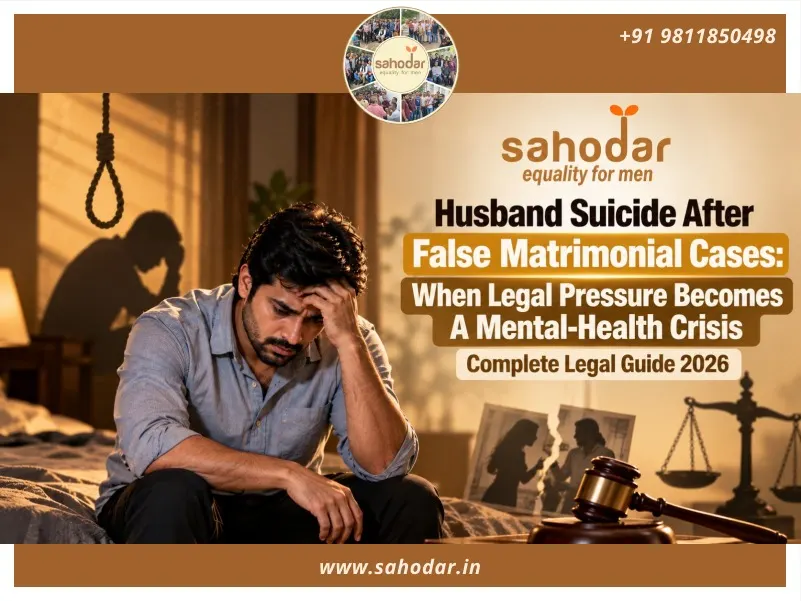
How False Matrimonial Allegations, Prolonged Court Battles and Financial Pressure Affect Husbands’ Mental Health—and What Indian Law Says About Mental Cruelty and Suicide
NEW DELHI: A husband fighting a matrimonial case is expected to attend court, respond to police notices, pay legal fees, contest maintenance demands and protect his family’s reputation.
But who checks whether he is mentally surviving this battle?
For some men facing false matrimonial cases, the damage goes far beyond the courtroom. Fear of arrest, separation from children, financial uncertainty and public humiliation can become overwhelming.
A man may eventually be acquitted. His innocence may be recognised. But what happens when prolonged legal pressure destroys his mental health before the court reaches a decision?
This is not merely a question about misuse of matrimonial laws. It is a question about the value Indian society places on a man’s life.
WHEN MATRIMONIAL LITIGATION BECOMES A MENTAL-HEALTH CRISIS
A criminal complaint does not establish guilt. Yet the social consequences of being accused can begin immediately.
A husband may face Section 498A IPC or Section 85 BNS proceedings, maintenance litigation, domestic violence complaints and child custody disputes, sometimes simultaneously.
Every proceeding requires time, money, preparation and emotional strength.
The pressure can become particularly severe when a man believes the allegations are fabricated but has no immediate way to establish that fact.
Constant anxiety, disturbed sleep, isolation, fear of losing employment and feelings of helplessness can seriously affect psychological well-being.
Not every person facing litigation develops a mental-health condition, and suicide is rarely explained by one event alone. However, severe legal, financial and relationship stress can contribute to an existing crisis.
A man defending himself in court should not have to defend his right to psychological support.
NCRB DATA EXPOSES THE SCALE OF MALE SUICIDES IN INDIA
According to the National Crime Records Bureau’s Accidental Deaths & Suicides in India 2024 report, released in May 2026:
- India recorded 1,70,746 suicides in 2024.
- 73.5% of suicide victims were male.
- Nearly 69% of male suicide victims were married.
The figures demand serious attention to men’s mental health in India.
However, they do not establish that false 498A complaints, matrimonial litigation or wives caused these suicides. Being married is a demographic characteristic, not proof of a particular cause of death.
That distinction is essential for credible men’s rights advocacy.
India needs better research into how family conflict, financial distress, prolonged litigation and inadequate mental-health support may interact in cases involving married men.
FALSE 498A CASES IN INDIA: WHAT THE SUPREME COURT SAYS ABOUT MISUSE OF MATRIMONIAL LAWS IN 2026
India’s criminal law changed significantly on July 1, 2024, when the Bharatiya Nyaya Sanhita (BNS), 2023 came into force.
Section 85 BNS, read with Section 86 BNS, replaces the earlier Section 498A IPC, providing punishment for cruelty committed against a married woman by her husband or his relatives. Older offences remain subject to the applicable IPC provisions and transitional legal rules.
While these laws protect genuine victims of matrimonial cruelty, the Supreme Court has repeatedly cautioned against their misuse through vague allegations and indiscriminate prosecution of family members.
In Shobhit Kumar Mittal v. State of Uttar Pradesh, 2025 INSC 1152, decided on September 24, 2025, the Supreme Court quashed criminal proceedings against a husband’s brother under Sections 498A and 323 IPC and Sections 3 and 4 of the Dowry Prohibition Act.
The Court found that the complaint contained vague, general allegations without specific details of the alleged harassment or any clearly established role for the accused brother-in-law.
The Supreme Court also emphasised that genuine victims of cruelty must remain free to seek legal protection.
Matrimonial laws must protect victims, not become weapons of harassment. A husband and his family deserve fair investigation, due process and protection against criminal proceedings unsupported by specific allegations.
SUPREME COURT: PROVEN FALSE COMPLAINTS CAN AMOUNT TO MENTAL CRUELTY
Indian law recognises that deliberately false criminal accusations can inflict serious matrimonial harm.
In K. Srinivas v. K. Sunita, (2014) 16 SCC 34, the Supreme Court found that the wife had knowingly and intentionally filed a false criminal complaint against her husband and seven family members.
The Court granted divorce under Section 13(1)(ia) of the Hindu Marriage Act, holding that even one such false complaint could constitute matrimonial cruelty.
Similarly, in Raj Talreja v. Kavita Talreja, (2017) 14 SCC 194, the Supreme Court recognised that patently false and defamatory accusations against a spouse may amount to cruelty.
Importantly, the Court also clarified that an acquittal or an unsuccessful complaint does not automatically establish deliberate fabrication.
These judgments establish two principles: genuine complainants have a right to legal remedies, and spouses who deliberately misuse criminal complaints are not immune from the consequences.
HUSBAND’S SUICIDE: WHEN DOES LEGAL HARASSMENT BECOME ABETMENT?
Can a husband’s suicide following matrimonial litigation make his wife or in-laws criminally liable? The Supreme Court has clarified that mental distress, even when linked to legal proceedings, does not automatically establish abetment of suicide.
In Patel Joshnaben Pravinkumar Patel & Ors. v. State of Gujarat & Anr., 2026 INSC 886, , the Supreme Court examined the suicide of a husband whose wife had filed an FIR under Sections 498A and 323 IPC and issued a maintenance notice.
Following his death, his wife’s parents and brother faced allegations of harassment and abetment of suicide.
The Supreme Court examined the FIR, suicide note and surrounding circumstances and found no specific conduct amounting to criminal abetment by the accused relatives. It consequently quashed the proceedings against them.
Significantly, the Court held that merely filing an FIR, even if it is false, does not automatically constitute instigation to suicide. The Court did not find the wife’s complaint to be false; it noted that her allegations had prima facie medical support.
Under Section 108 BNS (earlier Section 306 IPC), abetment of suicide carries imprisonment of up to ten years and a fine. Criminal liability requires evidence that satisfies the legal ingredients of abetment, such as instigation, conspiracy, or intentional aid. A suicide note blaming someone is not conclusive proof.
But an equally serious question remains: What happens to a husband’s mental health when matrimonial disputes, criminal proceedings and financial pressures become unbearable?
The law rightly demands evidence before imposing criminal liability. Yet the absence of legally established abetment does not mean a man’s psychological suffering should be ignored. A husband’s mental-health crisis deserves attention before it becomes a tragedy, not merely legal scrutiny after his death.
ATUL SUBHASH CASE: KARNATAKA HIGH COURT QUESTIONS ABETMENT IN HUSBAND’S SUICIDE
The suicide of Bengaluru techie Atul Subhash exposed a disturbing concern surrounding men’s mental health, alleged matrimonial harassment and prolonged legal battles.
Open Now- Atul Subhash Case Shonee Kapoor Podcast
Before his death, Subhash left a 24-page note and a video accusing his estranged wife and her family of harassment through allegedly false matrimonial cases. His wife, mother-in-law and brother-in-law subsequently faced abetment of suicide charges under Section 108 BNS.
During a hearing on March 4, 2026, the Karnataka High Court, while considering their petition to quash the criminal proceedings, raised a significant question.
Justice S.R. Krishna Kumar asked:
“If the husband feels that the wife is harassing him and he commits suicide, is that not abetment to suicide?”
The Court questioned whether the allegations could be dismissed without examining the evidence. With 50 witness statements forming part of the chargesheet, it directed the parties to identify the material supporting or contradicting the prosecution’s case.
The judge’s remarks were oral observations, not a finding of guilt, and the allegations against the accused remained subject to judicial scrutiny.
But the case raises an uncomfortable question about how seriously society and the justice system recognise psychological distress among husbands fighting matrimonial disputes.
A husband’s mental suffering should matter while he is alive, not only when his suicide becomes the subject of criminal proceedings.
HUSBAND’S SUICIDE VS WIFE’S SUICIDE: DOES INDIAN LAW OFFER EQUAL PROTECTION?
Indian law contains a significant gender-based distinction in cases involving abetment of suicide within marriage.
Under Section 117 of the Bharatiya Sakshya Adhiniyam, 2023 (earlier Section 113A of the Indian Evidence Act), when a married woman dies by suicide within seven years of marriage and cruelty by her husband or his relatives is established, the court may presume abetment of suicide, after considering all surrounding circumstances.
But when a husband dies by suicide after alleged cruelty or harassment by his wife, no equivalent statutory presumption exists.
Although Section 108 BNS (earlier Section 306 IPC) is gender-neutral and allows prosecution of anyone who abets suicide, the evidentiary protection under Section 117 BSA specifically applies to married women.
This does not mean that husbands are denied legal remedies or that a wife’s guilt should be presumed. Abetment must still be established through legally sufficient evidence.
However, the difference raises a legitimate question of equal legal protection.
If matrimonial cruelty can have devastating psychological consequences for either spouse, why should the law provide a specific evidentiary presumption for one gender alone?
India needs serious legislative discussion on gender-neutral safeguards, equal access to justice and recognition of men’s mental-health struggles.
WHAT HUSBANDS SHOULD DO WHEN FACING FALSE MATRIMONIAL CASES AND MENTAL HARASSMENT
A husband facing suspected false matrimonial cases needs a legal strategy. If he is experiencing severe distress, he also needs immediate personal support.
Five practical steps matter:
- Get legal assistance early. Understand the FIR, applicable arrest safeguards, bail options, and possible remedies instead of reacting to rumours or threats.
- Preserve evidence lawfully. Keep court documents, financial records, relevant messages, threats, and details of proceedings, and do not destroy or fabricate evidence.
- Tell someone about the distress. Speak honestly with trusted family members, friends or a mental-health professional. Do not isolate yourself.
- Seek urgent help when warning signs appear. Expressions of hopelessness, thoughts of suicide or an inability to cope require immediate attention, not dismissal.
- Separate litigation from personal safety. A pending criminal case can be contested through law. No hearing, allegation or financial dispute should prevent someone from seeking life-saving care.
India’s government-supported Tele-MANAS service offers mental-health assistance at 14416. Where there is an immediate threat to life, call 112 or seek emergency medical care.
Sahodar also provides peer-support and legal-awareness resources for men dealing with matrimonial disputes.
FALSE MATRIMONIAL CASES AND HUSBAND SUICIDES: WHY INDIA NEEDS URGENT LEGAL REFORMS
A husband facing criminal complaints, mounting legal expenses, repeated court hearings and separation from his children may be fighting more than a legal battle. He may also be struggling with severe psychological distress that remains unnoticed until it is too late.
India needs faster judicial proceedings, stronger safeguards against proven misuse of matrimonial laws and accessible mental-health support for men. Lawyers, families and institutions must recognise that psychological suffering is not determined by gender.
Seeking counselling is not an admission of guilt. Speaking about mental distress is not a sign of weakness.
Genuine victims of domestic abuse deserve protection, but deliberately false accusations must also carry legal consequences where established through due process.
Justice cannot be measured only by convictions, acquittals or closed cases. It must also protect the dignity, mental health and lives of those caught in prolonged matrimonial disputes.
HUSBAND SUICIDE AFTER MATRIMONIAL CASES: JUSTICE MUST BEGIN BEFORE TRAGEDY
When a husband dies by suicide amid matrimonial litigation, the debate often begins over false allegations, legal harassment and criminal liability. But by then, a life has already been lost.
Justice should not begin only when a husband’s suicide note becomes evidence.
The legal system must ensure fair investigations, protect genuine victims, safeguard the rights of accused husbands, and recognise the psychological distress prolonged legal battles cause.
No man should be pushed into silence by fear of social humiliation, financial ruin or endless courtroom proceedings. A husband’s mental health deserves attention while he is alive, not sympathy after his death.
An accused husband has the right to defend himself in court. He also has the right to survive the battle.
CONCLUSION
False matrimonial allegations, prolonged litigation, financial pressure and social humiliation can have devastating consequences for a husband’s mental health. While Indian courts recognise proven false criminal complaints as matrimonial cruelty, the psychological suffering of men caught in legal disputes often receives inadequate attention.
India needs timely justice, safeguards against misuse of matrimonial laws, gender-neutral legal protections and accessible mental-health support for men. Genuine victims deserve protection, but deliberately false allegations must also attract appropriate legal consequences.
A husband’s life cannot become collateral damage in a matrimonial dispute. Justice must protect his dignity, mental health, and legal rights before tragedy strikes.
No man should have to lose his life for society to recognise his suffering.
FAQs
- Can false 498A cases amount to mental cruelty?
Yes. The Supreme Court recognises proven, deliberately false criminal allegations as matrimonial cruelty.
- Is a wife responsible if her husband dies by suicide?
Not automatically. Abetment under Section 108 BNS must be legally established.
- Is a suicide note enough to prove abetment?
No. Courts examine the suicide note alongside other evidence and circumstances.
- Can husbands take legal action against false matrimonial cases?
Yes. Depending on the facts, remedies include bail, discharge, quashing and action against proven false allegations.
- Where can husbands seek mental-health support?
Call Tele-MANAS at 14416 for mental-health support or 112 in an emergency.