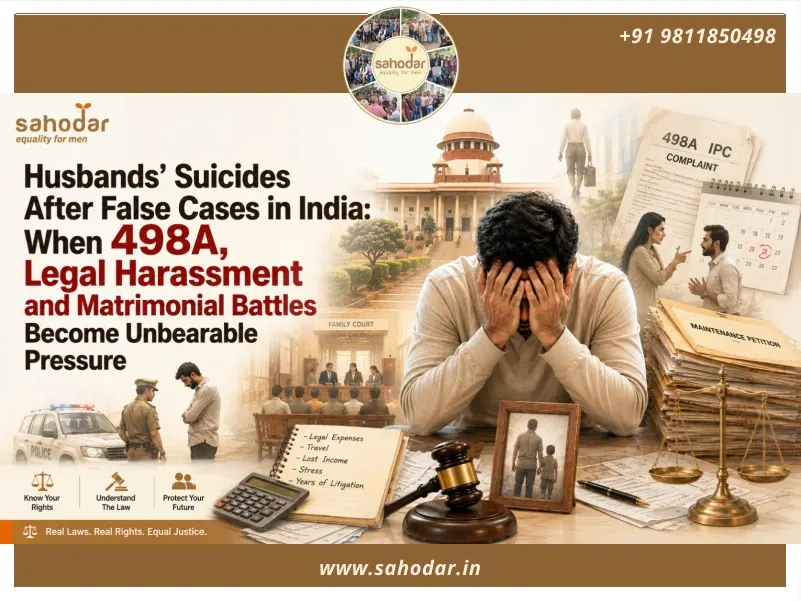
A Legal Analysis of Husbands’ Suicides, False 498A Cases, Matrimonial Harassment and the Growing Mental Health Crisis Among Married Men in India
NEW DELHI: A husband can fight a criminal case. He can fight a maintenance case. He can fight a Domestic Violence proceeding. He can fight for access to his child. He can answer allegations before the police, his employer, relatives and society.
The question nobody asks is: how many battles can the same man fight simultaneously before the pressure becomes unbearable?
For years, the discussion around false 498A cases in India has remained trapped between two extremes. One side treats virtually every matrimonial complaint as genuine. The other sometimes labels every acquittal or failed prosecution as proof that the original case was false.
Both positions are legally wrong.
A genuine victim of cruelty has every right to approach the law. But a man subjected to proven false allegations, malicious criminal proceedings, or litigation used as pressure is also suffering a real wrong.
And when that pressure ends in a husband’s suicide, the legal question becomes even more difficult: when does matrimonial harassment become abetment of suicide?
INDIA’S MALE SUICIDE NUMBERS CANNOT BE BRUSHED ASIDE
The latest NCRB Accidental Deaths & Suicides in India 2024 data records 1,70,746 suicides in India. The male-to-female ratio among suicide victims was 73.5:26.5. NCRB further records that nearly 69% of male suicide victims were married. It identifies “family problems”, excluding marriage-related problems, as the largest recorded cause category overall at 33.5%.
Those figures establish a serious men’s mental-health and suicide problem. They do not, however, establish that 498A, maintenance litigation or wives caused 69% of male suicides.
That distinction matters.
If we demand evidence before branding a husband guilty, we must apply the same standard when making allegations against a wife.
But refusing to misuse statistics does not mean we should ignore what the statistics are telling us. Men constitute nearly three-fourths of recorded suicide victims, and a substantial majority of male victims are married. That deserves serious research, institutional attention and a support system directed specifically at men.
498A HAS A NEW NUMBER, BUT THE LEGAL ISSUE HAS NOT DISAPPEARED
Since 1 July 2024, the Bharatiya Nyaya Sanhita, 2023 has replaced the Indian Penal Code for the new criminal-law regime. What the public still commonly calls Section 498A IPC is now substantially dealt with by Sections 85 and 86 BNS. Section 85 punishes a husband or his relative for subjecting a woman to cruelty, while Section 86 defines the cruelty covered by that provision.
Changing the section number did not end the debate over misuse.
In Shobhit Kumar Mittal v. State of Uttar Pradesh, 2025 INSC 1152, the Supreme Court reiterated the need for careful scrutiny of vague matrimonial accusations and quoted its earlier warning about the tendency in some cases to use Section 498A as an instrument of personal vendetta or “arm-twisting”. At the same time, the Court expressly clarified that genuine victims of cruelty should not remain silent.
Protect a woman who is genuinely subjected to cruelty. Protect a man and his family when criminal law is deliberately misused. One does not require sacrificing the other.
ACQUITTAL DOES NOT AUTOMATICALLY MEAN A FALSE CASE
This is one of the most important legal qualifications in this debate.
A husband being acquitted does not, by itself, prove that his wife deliberately fabricated the complaint. Cases fail for many reasons, including insufficient evidence, hostile witnesses, evidentiary gaps or failure to satisfy the criminal standard of proof.
The Supreme Court made the distinction clearly in Raj Talreja v. Kavita Talreja, (2017) 14 SCC 194. Merely filing a complaint does not amount to matrimonial cruelty when there is justification for filing it. Even an acquittal does not automatically make the accusation cruel. But where allegations are found to be patently false, false accusations can constitute matrimonial cruelty.
This distinction should govern every discussion about a false 498A case.
Call a case false when there is material demonstrating falsity, fabrication, malicious prosecution, contradictory evidence, a judicial finding, a police finding or other reliable evidence. Do not convert every unsuccessful prosecution into a false case merely for a headline.
SUPREME COURT HAS RECOGNISED FALSE CRIMINAL CASES AS MENTAL CRUELTY
The law recognises the damage deliberately false allegations can cause inside a marriage.
In K. Srinivas Rao v. D.A. Deepa, (2013) 5 SCC 226, the Supreme Court dealt with false and defamatory allegations and repeated proceedings against a husband and his family. The Court found that the wife’s conduct caused mental cruelty and granted divorce.
The Supreme Court went further in K. Srinivas v. K. Sunita, (2014) 16 SCC 34. On the facts before it, the Court found that the wife had knowingly and intentionally filed a false criminal complaint against the husband and seven members of his family. The Court held that even that complaint was sufficient in those circumstances to constitute matrimonial cruelty and dissolved the marriage.
Therefore, saying that false criminal allegations can amount to mental cruelty against a husband is not men’s-rights rhetoric. It is established Supreme Court jurisprudence.
But mental cruelty for divorce and criminal abetment of suicide are two different legal questions.
WHEN DOES HARASSMENT BECOME ABETMENT OF A HUSBAND’S SUICIDE?
Under the current law, Section 108 BNS deals with abetment of suicide and provides punishment extending to ten years’ imprisonment and a fine. It corresponds substantially with the earlier Section 306 IPC.
A death by suicide does not automatically make every person blamed by the deceased criminally liable.
The prosecution must establish abetment. Broadly, that requires legally relevant conduct such as instigation, intentional aid or another form of abetment recognised by criminal law, together with the required mental element.
This is where the Supreme Court delivered an extremely important judgment only days ago.
SUPREME COURT’S AUGUST 2026 RULING IS CRITICAL FOR THIS DEBATE
In Patel Joshnaben Pravinkumar Patel & Ors. v. State of Gujarat & Anr., 2026 INSC 886, decided on 18 August 2026, the deceased husband had faced an FIR from his wife under Sections 498A and 323 IPC as well as a maintenance notice. After his death by suicide, his brother alleged that the wife’s relatives had harassed him, that a false FIR had been filed and that these circumstances had driven him to suicide.
The Supreme Court examined the suicide note and surrounding circumstances. It held that the material did not disclose the necessary ingredients of abetment against the wife’s relatives.
Most significantly, the Court said that “lodging an FIR, even if it is false” does not by itself amount to instigating somebody to die by suicide. It also emphasised that courts cannot look only at accusations contained in a suicide note. The Court must examine the surrounding circumstances and the actual conduct attributed to the accused.
The Court ultimately quashed the abetment FIR and consequential proceedings against the appellants.
This judgment destroys two lazy arguments at once.
First, nobody can simply say, “The husband named somebody in his suicide note, therefore that person is guilty.”
Second, nobody should interpret that legal threshold to mean that psychological or legal harassment of husbands is imaginary.The criminal law requires proof of abetment, not merely proof that a man was distressed.
THERE IS ALSO AN IMPORTANT EVIDENTIARY DIFFERENCE FOR HUSBANDS
The Bharatiya Sakshya Adhiniyam, 2023 contains a specific provision in Section 117 concerning the suicide of a married woman.
Where a married woman dies by suicide within seven years of marriage, and the prescribed cruelty is shown, the court may presume, having regard to all circumstances, that the suicide was abetted by her husband or his relative.
There is no corresponding mirror statutory presumption specifically for the suicide of a married husband.
That does not mean a wife or her relatives can never be prosecuted when a husband dies by suicide. They can. Section 108 BNS is gender-neutral.
But in a husband’s case, the prosecution ordinarily has to establish the ingredients of abetment without the benefit of a husband-specific equivalent of Section 117 BSA.
That difference deserves to be part of any serious discussion on gender-neutral matrimonial laws in India.
ATUL SUBHASH TURNED THE ISSUE INTO A NATIONAL DEBATE
The death of Bengaluru tech professional Atul Subhash in December 2024 brought the issue of matrimonial litigation and men’s suicide into national consciousness.
He left written and video material accusing his estranged wife and her relatives of harassment amid matrimonial proceedings. Police subsequently registered an FIR for alleged abetment under Section 108 read with Section 3(5) BNS.
It is equally important to state what the law requires us to state: allegations made by a deceased person, an FIR, arrest, bail or a chargesheet do not themselves establish the guilt of the accused.
The proceedings have nevertheless produced a striking courtroom exchange.
During a Karnataka High Court hearing, Justice S.R. Krishna Kumar orally asked:
“If the husband feels that the wife is harassing him and he commits suicide, is that not abetment to suicide?”
The Court did not decide guilt through that question. It said the evidence would have to be examined and noted that the chargesheet reportedly contained statements of 50 witnesses.
That distinction is vital. An oral observation is not a conviction or a final judicial finding.
The Atul Subhash case should therefore be discussed as an ongoing criminal proceeding and a major national debate, not converted into a final verdict that a court has not yet delivered.
THE SUPREME COURT ONCE CALLED THE MARRIED MEN SUICIDE ARGUMENT “ONE-SIDED”
In 2023, a PIL in Mahesh Tiwari v. Union of India sought guidelines concerning suicides by married men and establishment of a National Commission for Men.
A Bench comprising Justices Surya Kant and Dipankar Datta declined to entertain the petition. During the hearing, the Court questioned whether the petition was portraying a “one-sided picture” and stressed that suicide depends on the facts of the individual case. The petition was ultimately withdrawn.
Legally, the Court was correct to resist an automatic inference that every married man’s suicide was caused by his wife.
But that cannot end the policy conversation.
The latest NCRB data still shows that men constitute 73.5% of suicide victims and that nearly 69% of male suicide victims were married. A country can reject simplistic causation and still ask why male distress receives so little institutional focus.
LEGAL HARASSMENT CAN BEGIN LONG BEFORE THE FINAL JUDGMENT
For an innocent husband, the damage from a false or malicious matrimonial case does not begin with conviction. It can begin the moment the complaint is filed.
Police visits, anticipatory-bail proceedings, repeated court appearances, allegations against ageing parents, maintenance litigation, child-access disputes, legal expenses, workplace stigma, and years spent defending oneself can together create enormous pressure.
The Supreme Court has repeatedly cautioned against vague and omnibus allegations in matrimonial disputes. In Shobhit Kumar Mittal v. State of Uttar Pradesh & Anr., 2025 INSC 1152, the Supreme Court emphasised the need for specific allegations while dealing with criminal proceedings arising from matrimonial disputes and quashed the proceedings against the husband’s brother where the accusations lacked sufficient specificity.
This does not mean every matrimonial complaint is false.
It means something more important: when misuse is established, its human cost cannot be measured only by the eventual acquittal or quashing order. By then, the process itself may already have become the punishment.
WHAT INDIA NEEDS TO CHANGE
India does not need weaker protection for genuine female victims. It needs stronger protection against proven misuse, irrespective of gender.
Investigators and courts must scrutinise specific allegations rather than treating every relative as part of a matrimonial package. Proven deliberately false complaints should carry meaningful legal consequences under the laws that already punish false evidence, false information, fabrication and malicious proceedings where their ingredients are established.
Matrimonial cases also need faster disposal. A legal system cannot casually allow a human being to spend the productive years of his life moving between police stations, criminal courts, Family Courts and maintenance proceedings and then declare that justice eventually prevailed.
Most importantly, men’s mental health cannot remain an afterthought. A husband asking for psychological help during litigation is not admitting guilt. A man saying that he cannot handle the pressure should receive assistance before society reads his suicide note and suddenly discovers that he was suffering.
A MAN SHOULD NOT HAVE TO DIE BEFORE HIS SIDE IS HEARD
I have spent years seeing what prolonged matrimonial litigation can do to individuals and families.
My position remains simple.
A genuine victim deserves protection. A false accuser does not deserve immunity merely because of gender. An accused husband deserves due process, not a presumption of guilt. And a man’s life cannot become acceptable collateral damage of matrimonial warfare.
Every false case also damages genuine victims because every proven fabrication makes society more suspicious of the next genuine complaint.
Justice is not protecting one gender from another.
Justice is protecting the innocent from wrongdoing, whoever the innocent person happens to be.
And when a husband says that false matrimonial cases, legal harassment, financial pressure or separation from his children are destroying him, the answer cannot be: fight until the final judgment and hope you survive long enough to read it.
The law must protect life before it merely records death.
CONCLUSION
A husband’s suicide during a matrimonial battle cannot automatically prove that every allegation against him was false. But proven false cases, repeated litigation, financial pressure, reputational damage and prolonged legal harassment can create devastating psychological pressure.
Indian courts have recognised that false criminal allegations can amount to mental cruelty, while Section 108 BNS requires clear proof before anyone can be held criminally liable for abetment of suicide.
The larger issue is impossible to ignore: men form the overwhelming majority of India’s suicide victims, yet male mental health and legal distress during matrimonial litigation remain seriously under-discussed.
The answer is not weaker protection for genuine women victims. The answer is fair investigation, consequences for proven misuse, faster matrimonial trials and equal concern for a man’s life, dignity and mental health.
A man should not have to die before society starts asking whether the legal process itself became unbearable.
FAQs
- Is 498A still applicable in India in 2026?
For new offences, Sections 85 and 86 BNS now cover cruelty. Older cases may still proceed under Section 498A IPC. - Does a husband’s suicide note prove abetment?
A suicide note alone is not enough. Courts must examine conduct, intent and surrounding circumstances. - Can a false 498A case amount to mental cruelty?
Proven false or malicious criminal allegations can amount to mental cruelty against a husband. - Can a wife be prosecuted for her husband’s suicide?
Section 108 BNS is gender-neutral, but abetment must be proved with evidence. - Does acquittal in 498A automatically prove the case was false?
Acquittal alone does not prove fabrication. Material must show the allegations were false or malicious.