
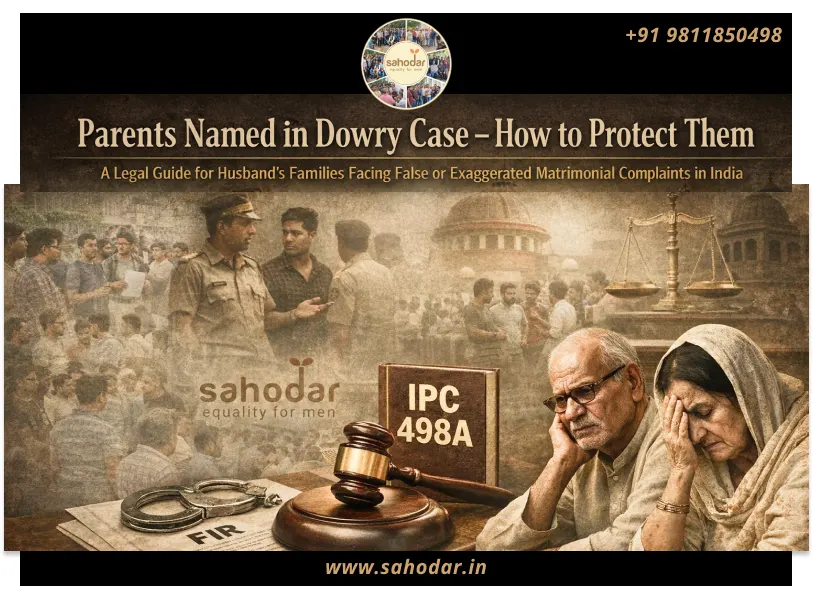
In thousands of matrimonial disputes, elderly parents are dragged into criminal dowry cases despite having little connection with the marriage. Courts have repeatedly warned against this practice—but most families discover their legal protections only after the FIR is filed.
NEW DELHI: Many families in India assume that marital disputes will eventually be resolved through discussion, mediation, or, at most, divorce proceedings. What they are rarely prepared for is when a personal disagreement suddenly escalates into a criminal complaint involving the entire household.
In many cases, a dispute between husband and wife leads to an FIR under dowry or cruelty laws, where not only the husband but also elderly parents, siblings living in other cities, and even distant relatives are named as accused. For many parents, especially those in their 60s or 70s, this becomes their first encounter with criminal litigation and the risk of arrest.
Courts across India have repeatedly acknowledged this pattern and warned against implicating entire families through vague and omnibus allegations. Yet such cases continue to arise, and most families only learn about their legal protections after the FIR has already been filed.
This article explains the legal framework governing such situations and the remedies available when parents are unnecessarily dragged into matrimonial criminal complaints.
Why Parents Are Commonly Named in Dowry Complaints
The practice of naming multiple relatives in matrimonial FIRs is not accidental. It often emerges from the way complaints are drafted and registered.
Several factors contribute to this pattern.
- Broad wording of cruelty provisions: Indian criminal law allows prosecution not only of the husband but also “relatives of the husband” for cruelty related to dowry or harassment.
This broad wording allows complainants to include parents, siblings, and extended family members.
- Pressure tactics during matrimonial disputes: In many disputes, the objective of naming multiple family members is strategic. By increasing the number of accused persons, pressure is created on the husband to settle the dispute or agree to financial demands.
- FIR registration stage has limited scrutiny: At the stage of registering an FIR, police are not required to verify the truthfulness of allegations. If the complaint discloses a cognizable offence, it must generally be registered.
As a result, even exaggerated allegations often find their way into FIRs.
- Emotional escalation in marital disputes: Marital disputes are highly emotional. In some cases, the anger against the husband expands to include the entire family, regardless of their actual role in the marriage.
This leads to “omnibus allegations”—general accusations without specific acts attributed to each person.
Laws Commonly Used in Matrimonial Complaints
Several legal provisions are frequently invoked in matrimonial disputes.
Understanding these provisions helps families understand the nature of allegations they may face.
Section 498A IPC / Corresponding Provisions under BNS: Section 498A of the Indian Penal Code criminalizes cruelty by a husband or his relatives towards a married woman.
Cruelty includes:
- Harassment related to unlawful dowry demands
- Conduct likely to drive a woman to suicide
- Severe physical or mental harassment
Punishment can extend up to three years imprisonment and fine.
Because the provision explicitly includes “relatives of the husband,” parents are often named in such complaints.
Dowry Prohibition Act, 1961: Sections commonly invoked include:
- Section 3 – Penalty for giving or taking dowry
- Section 4 – Penalty for demanding dowry
These provisions criminalize both the giving and receiving of dowry, though in practice prosecutions typically focus on alleged demands by the husband’s side.
Protection of Women from Domestic Violence Act, 2005: The Domestic Violence Act provides civil remedies such as:
- Residence orders
- Protection orders
- Monetary relief
- Maintenance
- Compensation
Parents can sometimes be included in domestic violence proceedings if they are alleged to have participated in harassment.
What Courts Have Said About Implicating Parents in Matrimonial Cases
Indian courts have repeatedly cautioned against the indiscriminate inclusion of relatives in dowry cases.
Several landmark judgments illustrate this judicial concern.
- Kans Raj v. State of Punjab (2000): The Supreme Court observed that there is a growing tendency to implicate all relatives of the husband in dowry cases.
The Court warned that courts must carefully scrutinize allegations against family members, particularly when they are general in nature and unsupported by specific evidence.
- 2. Preeti Gupta v. State of Jharkhand (2010): In this important decision, the Supreme Court noted that:
A serious relook of Section 498A is warranted because many complaints are filed in the heat of the moment over trivial issues.
The Court emphasized that courts should examine allegations with great care before proceeding against relatives.
- Arnesh Kumar v. State of Bihar (2014): This case significantly changed how arrests are made in 498A cases.
The Supreme Court held that automatic arrest in dowry cases is unlawful and directed police to follow the safeguards under Section 41 CrPC before making arrests.
Police must now justify the necessity of arrest.
This judgment provides an important protection for elderly parents who might otherwise face immediate arrest.
- Geeta Mehrotra v. State of Uttar Pradesh (2012): The Supreme Court held that when allegations against relatives are vague and lack specific details, criminal proceedings against them should be quashed.
The Court observed that mere naming of relatives without specific allegations is insufficient to sustain prosecution.
- Kahkashan Kausar v. State of Bihar (2022): The Supreme Court again reiterated that implicating distant relatives with general allegations amounts to abuse of criminal law.
The Court emphasized that criminal proceedings should not be used as a tool for harassment.
What Happens After an FIR Is Filed
Once a matrimonial FIR is registered, the consequences for families can be immediate and serious.
These include:
Police investigation: Police may call accused persons for questioning and collect statements.
Arrest concerns: Although automatic arrest is restricted after the Arnesh Kumar judgment, the possibility of arrest still creates significant anxiety.
Court proceedings: Accused persons may need to seek anticipatory bail or appear before the court.
Social impact: Criminal cases carry significant social stigma, particularly for elderly parents.
Financial burden: Legal defence, court appearances, and documentation can create substantial financial strain.
Legal Remedies to Protect Parents
Despite these challenges, several legal remedies exist to protect innocent family members.
- Anticipatory Bail: Under Section 438 of the Criminal Procedure Code, a person fearing arrest can apply for anticipatory bail.
Courts frequently grant anticipatory bail to elderly parents where:
- Allegations are vague
- No direct role is attributed
- The accused live separately
- Quashing Petition Before High Court: Under Section 482 CrPC, High Courts have the power to quash criminal proceedings where:
- Allegations are baseless
- There is abuse of process of law
- The complaint lacks specific evidence
Many parents obtain relief through quashing petitions.
- Discharge During Trial: Even if charges are filed, accused persons can seek discharge if evidence is insufficient to proceed with trial.
Courts often discharge relatives where the complaint contains only general accusations.
- Evidence Showing Lack of Involvement: Parents can rely on documentary evidence such as:
- Proof of separate residence
- Medical records showing old age or illness
- Employment records showing they lived in another city
Such evidence often weakens allegations.
Preventive Steps Families Can Take
While it is impossible to completely eliminate the risk of false allegations, certain precautions can reduce vulnerability.
Maintain clear financial records: Documentation related to gifts, expenses, and financial transactions can prevent false dowry claims.
Preserve communication: Messages, emails, and call records may become important evidence during litigation.
Avoid escalation during disputes: Heated arguments or written threats can later be misinterpreted in legal proceedings.
Seek early legal advice: Legal consultation at the first sign of serious marital conflict can help families prepare for potential legal risks.
Balancing Protection for Victims with Safeguards for Families
Dowry laws were enacted to address genuine social problems involving harassment and violence against women.
However, the judicial system has also acknowledged that misuse of these provisions can cause serious injustice to innocent family members.
The challenge for courts is to strike a balance:
- ensuring real victims receive protection
- while preventing criminal law from becoming a tool of harassment.
Judicial scrutiny and evidence-based prosecution remain essential to maintaining this balance.
Conclusion: Knowing Your Rights Before a Crisis
For many families, the legal system becomes relevant only after a complaint is filed and the damage is already done.
Parents who had little involvement in the marriage suddenly face criminal charges, police investigations, and court proceedings.
However, Indian law does provide safeguards. Courts have repeatedly recognized the problem of indiscriminate prosecution of relatives and have developed legal principles to prevent misuse.
Understanding these protections early—before disputes escalate—can make a critical difference.
In matrimonial litigation, awareness of legal rights is often the first and most effective line of defence.
FAQs
- Can elderly parents be arrested in a dowry case?
Arrest is not automatic. The Supreme Court in Arnesh Kumar v. State of Bihar directed police to avoid routine arrests in Section 498A cases and to follow strict safeguards before taking anyone into custody, especially elderly relatives. - Can parents be named in a 498A case even if they live separately?
Yes, complaints often include parents and relatives even if they live in another city. However, courts have repeatedly held that vague or omnibus allegations against relatives are not sufficient to sustain criminal proceedings. - What can parents do if they are falsely implicated in a dowry complaint?
They can apply for anticipatory bail to prevent arrest and may approach the High Court for quashing of the FIR if the allegations are general, exaggerated, or unsupported by specific evidence. - Have courts acknowledged misuse of dowry laws against families?
Yes. The Supreme Court in cases such as Preeti Gupta v. State of Jharkhand and Kahkashan Kausar v. State of Bihar recognized the growing tendency to implicate entire families in matrimonial disputes through exaggerated allegations. - What is the most important protection for families facing false matrimonial cases?
Early legal action. Seeking legal advice immediately, preserving evidence, and approaching the court for bail or quashing can prevent unnecessary harassment of innocent parents and relatives.