
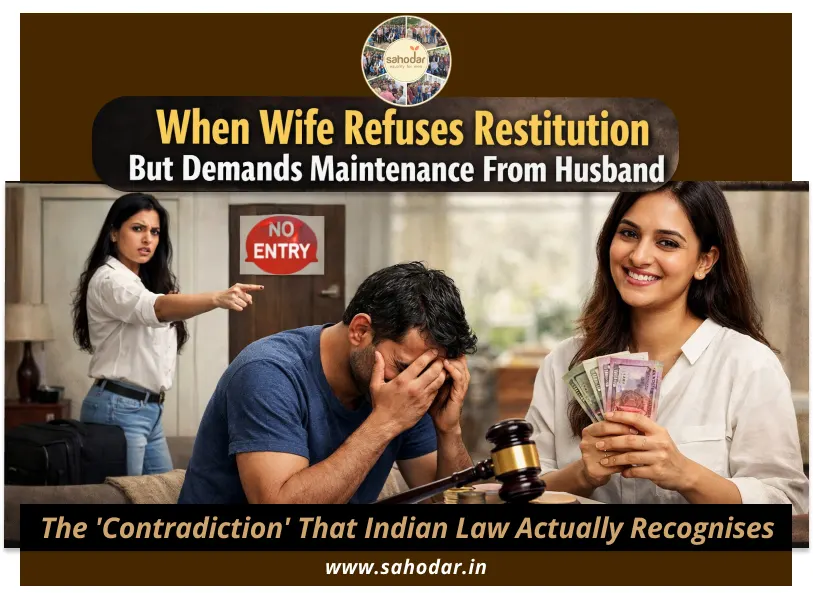
Can a husband win restitution and still be ordered to pay maintenance?
The Supreme Court clarifies that non-compliance with RCR does not automatically cancel support, the real test lies in proving “without sufficient reason.”
NEW DELHI: Indian matrimonial disputes often create a situation that appears contradictory at first glance. Many husbands ask a simple question:
If a wife refuses to live with her husband, how can she still demand maintenance?
This issue usually arises when a husband files a petition under Section 9 of the Hindu Marriage Act for restitution of conjugal rights, while the wife simultaneously pursues maintenance under Section 125 of the Criminal Procedure Code or other laws.
To understand this properly, one must first understand what Section 9 of the Hindu Marriage Act actually deals with. Section 9 applies when one spouse has withdrawn from the society of the other without reasonable excuse. The court then examines whether there was a genuine and lawful justification for living separately. If the court finds that there was no valid reason, it may pass a decree directing the spouse to resume cohabitation.
However, this decree does not automatically decide the question of financial support. Maintenance is governed by a different legal framework and serves a different objective. Section 125 of the Criminal Procedure Code is a social welfare provision designed to prevent neglect and ensure financial support to a dependent spouse.
But Section 125 itself contains an important restriction. Section 125(4) states that a wife is not entitled to maintenance if she is living in adultery, or if without sufficient reason she refuses to live with her husband, or if the parties are living separately by mutual consent. The key words here are “without sufficient reason” and “refuses to live”.
The Supreme Court, in a significant judgment dated 10 January 2025, clarified that a decree for restitution of conjugal rights obtained by the husband, and the wife’s failure to comply with that decree, does not automatically result in cancellation of maintenance. The Court clearly held that there is no rigid or automatic rule. The matter depends on facts and circumstances.
The Court examined the language of Section 125(4) and observed that the word “refusal” is important. A mere failure to return does not automatically amount to a legal refusal. “Refusal” implies a deliberate and unjustified rejection. Therefore, even if a decree for restitution exists, the wife may still claim maintenance if she can show that she had a sufficient reason to stay away.
This clarification is crucial because many husbands assume that once they obtain a restitution decree, maintenance will stop automatically. The Supreme Court has clarified that such an assumption is legally incorrect. The existence of a decree is a relevant factor, but it is not conclusive by itself.
In many cases, courts examine whether the wife had reasons such as cruelty, harassment, safety concerns, or other serious circumstances that justified living separately. If such reasons are proved or appear plausible on record, maintenance may continue despite non-compliance with a restitution decree.
At the same time, Section 125(4) remains a strong legal defence where evidence clearly shows that the wife is living separately without any sufficient cause. The husband can rely on contradictions in allegations, absence of specific incidents, voluntary separation, or evidence showing that the offer to resume cohabitation was genuine and bona fide. The burden of proving lack of sufficient reason becomes central to the case.
It is also important to note that maintenance claims can arise under multiple statutes. Under Section 24 of the Hindu Marriage Act, interim maintenance and litigation expenses may be granted during pending proceedings. Under Section 25 of the Hindu Marriage Act, permanent alimony may be awarded at the time of final decree or even later. Additionally, under Section 20 of the Protection of Women from Domestic Violence Act, courts may grant monetary relief, which can include maintenance.
Because of multiple parallel proceedings, the Supreme Court in Rajnesh v Neha (2020) issued important guidelines to ensure uniformity, financial disclosure, and adjustment of overlapping maintenance orders. Courts now require detailed affidavits of income and liabilities to prevent misuse or duplication of financial claims.
Therefore, the apparent contradiction between restitution and maintenance is not a contradiction in law but a question of evidence. The real legal issue is whether the wife is living separately without sufficient reason. If sufficient reason exists, maintenance may continue. If it does not, Section 125(4) can operate as a bar.
For husbands, this means that emotional arguments about unfairness are unlikely to succeed. What matters is documentary evidence, cross-examination, financial disclosures, and careful legal strategy. A restitution decree is a supporting factor, not a guaranteed shield.
The Supreme Court’s 10 January 2025 clarification reinforces that matrimonial disputes must be decided on facts, not assumptions. Maintenance law focuses on financial support, while restitution law focuses on cohabitation. They operate in parallel but under different standards.
Ultimately, the outcome depends on whether the separation was justified. The phrase “without sufficient reason” becomes the deciding factor. Courts will not automatically presume refusal merely because cohabitation has not resumed. They will look deeper into conduct, circumstances, and credibility.
For many litigating husbands, this legal distinction explains why maintenance continues despite restitution decrees. The path to relief lies not in outrage, but in proving absence of sufficient cause with clear and credible evidence.
FAQ’s
- Can a wife claim maintenance even after refusing to live with her husband?
Yes. Under Section 125 CrPC, maintenance can continue unless the husband proves that she is living separately “without sufficient reason.” A restitution decree alone does not automatically cancel maintenance. - Does winning a Restitution of Conjugal Rights (RCR) case stop maintenance?
No. The Supreme Court has clarified that an RCR decree is not an automatic bar. Courts must separately examine whether the refusal to cohabit was unjustified. - What does “without sufficient reason” mean under Section 125(4) CrPC?
It means the wife must not have a valid legal justification such as proven cruelty, safety concerns, or serious harassment. If sufficient reason exists, maintenance may continue. - Can maintenance be challenged if the wife voluntarily left the matrimonial home?
Yes. If evidence shows voluntary separation without lawful cause, the husband can seek cancellation or reduction of maintenance under Section 125(4) CrPC. - Can maintenance be claimed under multiple laws at the same time?
Yes. Claims may arise under Section 125 CrPC, Section 24 or 25 of the Hindu Marriage Act, and Section 20 of the Domestic Violence Act. However, courts are required to adjust overlapping awards as per Supreme Court guidelines in Rajnesh v Neha (2020).