
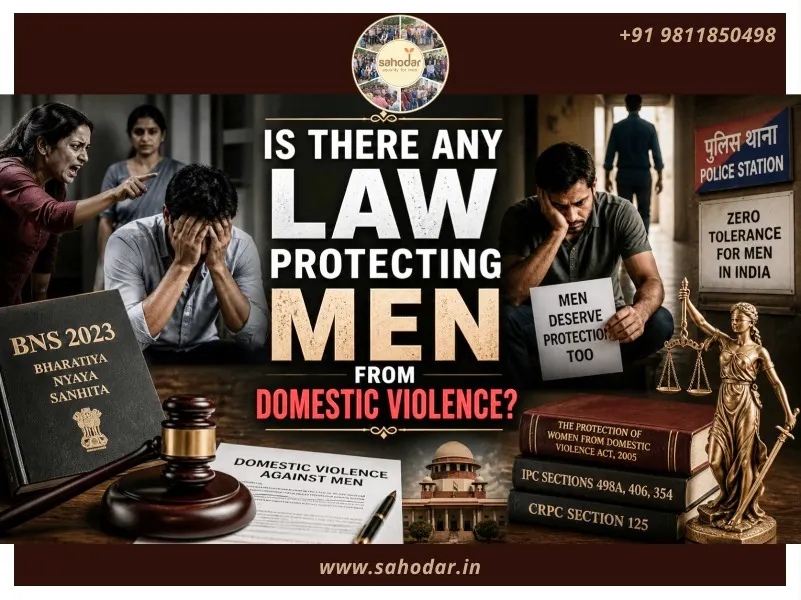
A critical analysis of domestic violence laws, legal gaps, judicial stance, and remedies available to men
NEW DELHI: Domestic violence is a recognized legal wrong in India, but the statutory framework addressing it is not gender-neutral. While the law provides a detailed, structured, and immediate remedy for women, there is no equivalent statutory protection for men facing similar abuse within domestic relationships.
This creates a fundamental imbalance: the legal system acknowledges the possibility of cruelty against men in matrimonial disputes, yet does not provide a direct protective mechanism. The issue is not merely legislative silence—it is the absence of enforceable, immediate relief for one class of victims.
Statutory Position: No Direct Protection for Men
Protection of Women from Domestic Violence Act, 2005
This statute is the primary legislation dealing with domestic violence in India. However, its scope is explicitly gender-specific.
- Section 2(a) defines an “aggrieved person” strictly as a woman.
- Reliefs such as protection orders, residence orders, and monetary relief are available only to women.
- Men, irrespective of the nature or severity of abuse, cannot invoke this Act.
The consequence is structural: even in cases involving documented emotional abuse, false allegations, or coercive conduct by a spouse, a man cannot seek protection under this law.
Indian Penal Code, 1860
The penal framework is technically gender-neutral in certain provisions, but it does not specifically address domestic violence against men.
Available sections include:
- Assault and criminal force (Sections 351–358)
- Criminal intimidation (Section 506)
- Defamation (Section 499)
However, these provisions:
- Are incident-specific, not relationship-specific
- Do not provide continuous protection (like restraining orders)
- Lack the immediacy and procedural support available under domestic violence legislation
Thus, while theoretically available, these provisions are inadequate substitutes for a dedicated domestic violence law.
Constitutional Safeguards: Theoretical but Not Practical
Article 14 of the Constitution of India
Article 14 guarantees equality before law and equal protection of laws. However, Indian courts have consistently upheld gender-specific legislation on the basis of “reasonable classification.”
This means that:
- Laws favouring women are constitutionally valid
- Absence of equivalent protection for men is not automatically unconstitutional
Article 21 of the Constitution of India
Article 21 protects the right to life and personal liberty, which includes:
- Mental peace
- Dignity
- Freedom from harassment
In theory, a male victim can approach High Courts under writ jurisdiction for protection. In practice:
- Writ remedies are discretionary
- They require high thresholds of proof
- They are not designed for routine domestic disputes
Thus, constitutional remedies remain exceptional, not practical.
Judicial Position: Recognition Without Remedy
Hiral P. Harsora v. Kusum Narottamdas Harsora (2016)
The Supreme Court struck down the phrase “adult male” from the definition of respondent under the DV Act, allowing women to proceed against female respondents as well.
However:
- The judgment did not alter the definition of “aggrieved person”
- Men still cannot seek protection under the Act
This reflects judicial expansion on one side without balancing the other.
Arun Vyas v. Anita Vyas (1999)
The Court acknowledged the complexities of matrimonial disputes and the potential for misuse of legal provisions. While not directly dealing with domestic violence against men, it reflects judicial awareness of:
- False allegations
- Litigation as a pressure tool
Despite such observations, no structural legal remedy has evolved.
High Court Observations
Various High Courts have, in different cases:
- Recognized mental cruelty inflicted upon husbands
- Noted false complaints and exaggeration in matrimonial litigation
However, these observations remain case-specific and do not translate into a statutory framework for protection.
Alternative Legal Remedies Available to Men
Criminal Law Remedies
A man may initiate criminal proceedings in appropriate circumstances:
- Assault complaints under IPC
- Criminal intimidation (Section 506 IPC)
- Defamation (Section 499 IPC)
Limitations:
- Require strong evidence
- Do not prevent ongoing harassment
- Often escalatory rather than protective
Matrimonial Law Remedies
Under Hindu Marriage Act, 1955:
- Section 13 allows divorce on grounds of cruelty
- Mental cruelty includes harassment, false allegations, and abusive conduct
However:
- This is a long-term remedy
- It does not provide immediate safety or relief
- It addresses exit, not protection
Civil Remedies
Civil options include:
- Injunctions
- Damages for defamation or harassment
These are:
- Procedurally complex
- Time-consuming
- Rarely effective in urgent domestic scenarios
Practical Reality: Law vs Ground Situation
The gap between legal theory and reality is significant.
- Police often hesitate to register complaints by men in domestic disputes
- Male victimhood is socially trivialized
- Counter-allegations are common, including:
- Cruelty under Section 498A IPC
- Proceedings under the DV Act
- Maintenance claims
The result is procedural imbalance:
- A man defending multiple proceedings simultaneously
- No equivalent forum for immediate protection
In many cases, the legal process itself becomes the punishment.
Misuse vs Non-Recognition: The Core Problem
The issue is two-fold:
- Expansion of protective laws without adequate safeguards against misuse
- Absence of parallel protection for men
This creates:
- Strategic litigation leverage
- Legal asymmetry in matrimonial conflicts
Where one party has immediate access to protection orders and residence rights, and the other has only reactive remedies.
Need for Reform: Gender-Neutral Domestic Violence Law
A balanced legal framework requires:
- Gender-neutral definition of “aggrieved person”
- Safeguards against false or exaggerated claims
- Equal access to:
- Protection orders
- Residence rights
- Compensation
Without such reform, the system continues to operate asymmetrically.
Conclusion: Legal Recognition Without Protection
Indian law does not deny that men can be victims of domestic abuse. Courts have acknowledged cruelty, harassment, and false implication in multiple cases.
However, recognition without remedy has limited value.
A man facing domestic abuse today has no direct statutory protection comparable to what is available to women. He must rely on fragmented legal provisions, slower remedies, and discretionary reliefs—none of which offer immediate or structured protection.
Until legislative reform introduces gender neutrality, the framework will remain incomplete—where protection exists, but not equally.
FAQs
- Is there any law in India that directly protects men from domestic violence?
No, there is no specific law; statutes like the Protection of Women from Domestic Violence Act, 2005 apply only to women. - Can a man file a domestic violence case against his wife?
No, a man cannot file under the DV Act; he must rely on general provisions of the Indian Penal Code, 1860 if applicable. - What legal remedy does a man have if he faces cruelty by his wife?
He can seek divorce on grounds of cruelty under the Hindu Marriage Act, 1955 or file criminal complaints depending on facts. - Can a man seek police help if he is facing domestic abuse?
Yes, he can approach the police and file a complaint under general provisions of the Indian Penal Code, 1860, but there is no dedicated domestic violence mechanism for men. - Do courts recognize that men can be victims of domestic abuse?
Yes, courts have acknowledged this in various cases, but no dedicated statutory protection mechanism exists.




Very nicely elaborated the Tragedy of Men who are not aggrieved person but victim of conduct of their monster (hidden or open) wives. Singham Judge required to deliver such Judgement which will protect innocent Men Community.