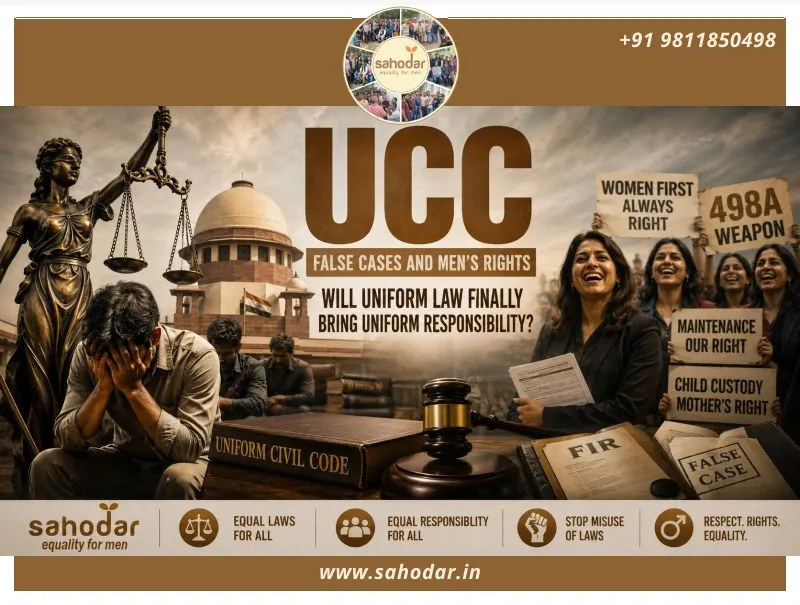
A Unifrom civil code will be meaningful only when marriage, divorce, maintenance, custody and legal consequences apply with the same standards to men and women.
NEW DELHI: The Uniform Civil Code debate is usually presented as a contest between religion and reform. That is incomplete.
For Indian families, the practical question is whether one uniform law will also create one uniform standard of responsibility.
A husband should not be treated as a permanent provider merely because he is male. A father should not become a visitor merely because the marriage failed. A wife should retain genuine protection against violence and abandonment. No person should be allowed to weaponise law without consequences.
Article 44 of the Constitution directs the State to endeavour to secure a Uniform Civil Code for citizens throughout India. But Article 44 does not prescribe the contents of that code. Uniformity by itself is therefore not justice. A one-sided rule imposed uniformly remains a one-sided rule.
Having entered this field after personally facing matrimonial litigation and later working with men affected by 498A, maintenance, domestic-violence and custody proceedings, I apply one test: Does the UCC create evidence-based, gender-neutral rights and duties, or merely repaint the same imbalance?
UCC IS NOT A MAGIC ERASER FOR FALSE CASES
The first legal fact must be made clear. A Uniform Civil Code principally concerns civil and personal-law subjects such as marriage, divorce, maintenance, succession, inheritance and related family relationships.
It does not automatically rewrite the Bharatiya Nyaya Sanhita, the Bharatiya Nagarik Suraksha Sanhita or the Protection of Women from Domestic Violence Act. Therefore, every alleged misuse of criminal and matrimonial law cannot be cured merely by passing a UCC.
The Protection of Women from Domestic Violence Act, 2005 defines an “aggrieved person” as a woman who alleges domestic violence in a domestic relationship.
Section 144 of the Bharatiya Nagarik Suraksha Sanhita, 2023 continues the summary maintenance remedy for a wife, children and parents. These laws do not become gender-neutral merely because marriage or inheritance is placed under a common civil code.
A serious UCC discussion must reject the false promise that one statute will solve every false case. Civil reform and criminal-law reform are connected, but they are not interchangeable.
WHAT A GENUINE UCC CAN CHANGE
A properly drafted UCC can still transform family law.
It can establish common rules for marriage, registration, monogamy, divorce, children, succession, inheritance, adoption, guardianship and financial relief.
It can remove incentives to change religion merely to escape an existing marital obligation and replace overlapping personal laws with one intelligible system.
The Supreme Court confronted one such conflict in the case of Sarla Mudgal v. Union of India AIR (1995) 3 SCC 635 .It held that a Hindu husband’s conversion to Islam did not automatically dissolve his existing Hindu marriage and that a second marriage contracted without legally ending the first marriage would be invalid.
In the case of Jose Paulo Coutinho v. Maria Luiza Valentina Pereira,(2019) 20 SCC 85 the Supreme Court described Goa as a “shining example” of a State with a uniform civil code, while also acknowledging limited exceptions.
Goa is not a perfect national template, but it demonstrates that a common framework for civil relations is neither constitutionally unimaginable nor administratively impossible.
UNIFORMITY WITHOUT GENDER NEUTRALITY IS UNIFORM DISCRIMINATION
Section 24 of the Hindu Marriage Act, 1955 permits either the wife or the husband, if lacking sufficient independent income, to seek maintenance during proceedings and litigation expenses.
That is gender-neutral drafting. The court must examine need, the parties’ incomes and what is reasonable in the circumstances.
But other major remedies remain expressly sex-specific.
The Domestic Violence Act is designed around a woman as the aggrieved person. The cruelty offence under Section 85 BNS is structured around the husband and his relatives as potential offenders.
The summary spousal-maintenance provision under Section 144 BNSS speaks of a wife and does not create a corresponding remedy for a financially dependent husband.This patchwork is contradictory.
The law recognises that a husband may be financially dependent under one statute, yet denies him equivalent status under another. It recognises female-perpetrated assault, economic abuse or coercive control as facts, but provides no equivalent domestic-violence remedy to a male victim.
A UCC worthy of its name must not ask only whether Hindus, Muslims, Christians and others have the same rule. It must also ask whether the same conduct attracts the same legal treatment when the sexes are reversed.
THE SUPREME COURT HAS ALREADY WARNED AGAINST LEGAL IMBALANCE
The demand for a UCC is not new.
In Mohd. Ahmed Khan v. Shah Bano Begum(1985) 2 SCC 556, the Supreme Court said that Article 44 had “remained a dead letter.”During the hearing, counsel was recorded as whispering, somewhat audibly, that “legislative competence is one thing, the political courage to use that competence is quite another.”The Court’s larger message was that case-by-case judicial repair cannot substitute for coherent legislation.The warnings about misuse of matrimonial criminal law are equally established.
In the case of Sushil Kumar Sharma v. Union of India(2005) 6 SCC 281 , the Supreme Court upheld Section 498A IPC but acknowledged that non-bona-fide complaints and oblique motives had surfaced.
It stressed that the provision’s constitutionality could not license personal vendetta or harassment. The case did not invalidate protection for genuine victims; it demanded safeguards against abuse.
In the case of Arnesh Kumar v. State of Bihar(2014) 8 SCC 273 , the Court recorded a phenomenal increase in matrimonial disputes and said Section 498A had acquired a “dubious place of pride” among provisions used as weapons rather than shields.
It issued arrest safeguards because arrest cannot be automatic merely because an offence is cognisable and non-bailable.
In the case of Kahkashan Kausar v. State of Bihar, (2022) 6 SCC 599 , the Supreme Court quashed proceedings against relatives where the allegations were general and omnibus.
It warned that false implication through sweeping allegations in matrimonial disputes, if unchecked, results in abuse of process and leaves severe scars even when a trial ultimately ends in acquittal.
These judgments do not say every wife is lying. They establish that protective legislation still requires scrutiny, specific allegations, fair procedure and judicial application of mind.
AN ACQUITTAL IS NOT AUTOMATIC PROOF OF A FALSE CASE
Men’s rights advocacy loses credibility when every failed prosecution is labelled false.
A criminal case may end because evidence was insufficient, witnesses were unreliable, the investigation was defective or the prosecution could not prove guilt beyond reasonable doubt.
None of these outcomes automatically establishes deliberate fabrication.
A false case must involve evidence that the complainant knowingly supplied false information, manufactured evidence, concealed decisive facts or initiated proceedings without a just or lawful ground and with intent to injure.
This distinction protects genuine complainants while permitting firm action against proven misuse.
Where deliberate fabrication is actually proved, existing criminal law is not powerless.
Section 229 BNS punishes intentionally giving or fabricating false evidence in a judicial proceeding with imprisonment that may extend to seven years and a fine.
Section 248 BNS punishes a knowingly false criminal charge made with intent to injure. The aggravated provision may extend to ten years where the false charge concerns an offence punishable with death, life imprisonment or imprisonment of ten years or more.
Procedural restrictions under Section 215 BNSS may require a written complaint from the concerned court where specified offences are committed in or in relation to judicial proceedings.
The defect is often not absence of law, but rare and inconsistent enforcement after fabrication is proved.
MAINTENANCE MUST FOLLOW DISCLOSURE, NOT GENDERED ASSUMPTION
An economically dependent spouse or child should not be abandoned.
But maintenance cannot rest on concealment, inflated claims or an assumption that every man has unlimited earning capacity.
In the case of Rajnesh v. Neha,(2021) 2 SCC 324 the Supreme Court attempted to bring national discipline to maintenance litigation.
It prescribed affidavits for the disclosure of assets and liabilities, addressed overlapping maintenance proceedings and directed courts to consider earlier maintenance orders so that relief is adjusted rather than duplicated
The judgment’s logic is crucial for any UCC: financial support must be decided from verified data, actual need, income, liabilities and the marital standard of living—not stereotypes.
A fair UCC should therefore provide:
- Mandatory financial disclosure by both parties;
- Consequences for hiding income, assets or employment;
- Set-off for maintenance already awarded under another proceeding;
- A reasoned assessment of earning capacity without fictional income;
- Equal eligibility for a genuinely dependent spouse, regardless of sex; and
- Periodic review when income, employment, custody or dependency materially changes.
The claimant must disclose honestly and the respondent must pay fairly. Maintenance cannot become punishment or evasion.
DIVORCE LAW MUST STOP REWARDING DEAD MARRIAGES
India’s matrimonial system often forces parties to continue litigating after the marriage has ended in every practical sense.
In the case of Shilpa Sailesh v. Varun Sreenivasan2023 SCC OnLine SC 544,, a Constitution Bench held that the Supreme Court may, in its discretion under Article 142, dissolve a marriage on the ground of irretrievable breakdown.
But ordinary spouses should not need to reach the Supreme Court to obtain a remedy for a marriage that is emotionally dead, unworkable and beyond repair.
A national UCC should recognise irretrievable breakdown as a statutory ground, with safeguards for children, residence, property and support, while discouraging tactical delay.
When dignified exit becomes nearly impossible, parties gain incentives to manufacture leverage and prolong conflict.
Faster, evidence-based divorce prevents a failed marriage from becoming lifelong litigation.
CHILD CUSTODY CANNOT TREAT FATHERS AS OPTIONAL PARENTS
The welfare of the child must remain paramount. But “welfare” cannot become a slogan used to normalise one parent’s exclusion.
A modern UCC should presume meaningful relationships with both fit parents.
Shared parenting need not mean mechanical fifty-fifty residence. Custody and access should preserve both parental relationships unless evidence shows abuse, neglect or a serious welfare risk.
In custody disputes, even an untested accusation can suspend access during a child’s formative years. If it later fails, lost childhood cannot be restored by a final order.
The code should require time-bound scrutiny of serious allegations, safe interim contact, enforcement of access orders and consequences for proven parental alienation.
A father is not a wallet with visitation rights. A mother is not merely a caregiver without financial agency. Both are parents, and the child is not matrimonial property.
UTTARAKHAND SHOWS THE PROMISE—AND THE LIMITS—OF UCC
Uttarakhand has moved beyond political discussion to an operating UCC framework.
Its official portal currently provides services for marriage registration, divorce or nullity registration, live-in relationship registration, succession and wills under the 2025 Rules.
The State’s official government-order page also records amendment measures in 2025 and a Uniform Civil Code Amendment Act in 2026.
Common registration may improve proof and reduce disputes.
But every provision must still be tested for privacy, due process, equal treatment and proportionate penalties. A common form is not the same as common justice.
MADHYA PRADESH IS THE NEW TEST CASE
The Madhya Pradesh Assembly has passed its Uniform Civil Code Bill, but the Bill still requires the Governor’s approval before it comes into force.
Official reporting states that the Bill proposes compulsory marriage registration, mandatory registration of live-in relationships within one month, a bar on multiple marriages, legal-process requirements for divorce and equal inheritance rights for men and women, while excluding tribal communities from its scope.
That status must be reported accurately: a Bill passed by the Assembly is not yet an enforceable Act merely because the political announcement is dramatic.
The Madhya Pradesh model must be examined clause by clause.
Does it punish identical conduct identically, bind both live-in partners, protect privacy, provide a hearing and distinguish registration failure from fraud or exploitation?
Uniformity cannot be judged from the name of the Bill. It must be judged from who bears the liability and who receives the protection.
THE MEN’S RIGHTS TEST FOR ANY UCC
I would measure any proposed UCC against seven non-negotiable standards.
- One law, same definitions: Cruelty, desertion, adultery, economic abuse, abandonment and coercive control must be defined by conduct, not by the gender of the person committing them.
- One duty of disclosure: Both parties must disclose their income, property, liabilities and prior proceedings through affidavits before interim financial orders are passed.
- One standard for falsehood: Proven fabrication, suppression of facts or perjury must carry real consequences, regardless of whether the wrongdoer is male or female.
- One rule for financial support: Maintenance should depend on actual need, financial means, caregiving responsibilities and earning capacity—not automatic liability based on gender.
- One child-welfare framework: Shared parenting and enforceable access should be the norm for fit parents, subject to evidence-based exceptions concerning the child’s welfare.
- One exit from a dead marriage: Irretrievable breakdown of marriage should become a statutory ground for divorce with time-bound adjudication.
- One system of accountability: Wrongful arrest, malicious prosecution, repeated non-compliance and deliberate misuse should lead to costs, compensation or prosecution where the legal requirements are proved.
These standards protect genuine victims by separating real abuse from strategic litigation and preserving confidence in protective laws.
UNIFORM LAW MUST MEAN UNIFORM CONSEQUENCES
India needs coherence in marriage, divorce, inheritance, adoption, maintenance and family procedure.
Men should not celebrate a UCC merely because different religions receive the same statute.Citizens must receive the same evidentiary standard, support rights, parental status and consequences for proven wrongdoing.
A bad law does not become just because it is applied nationwide.A genuine Uniform Civil Code must deliver equal law, equal procedure, equal responsibility and equal consequences.
Otherwise, the country will achieve uniformity on paper while preserving discrimination in practice.That would not be reform.It would only be old injustice under a new name.
FAQs
- Will UCC automatically end false 498A or DV cases?
A UCC mainly reforms civil and personal laws. Separate amendments to criminal and domestic violence laws are required. - Is India under a national UCC today?
India has no central nationwide UCC in force. Uttarakhand operates a State UCC framework, while Madhya Pradesh’s Bill awaits the Governor’s approval as of July 25, 2026. - Can a UCC make maintenance gender-neutral?
It can base spousal support on proven need, income, liabilities and caregiving responsibilities rather than gender. - Does every acquittal prove a false matrimonial case?
Deliberate falsity must be established independently through evidence and specific judicial findings. - What should men demand from a UCC?
Gender-neutral remedies, honest financial disclosure, shared parenting, faster divorce and strict action against proven misuse.