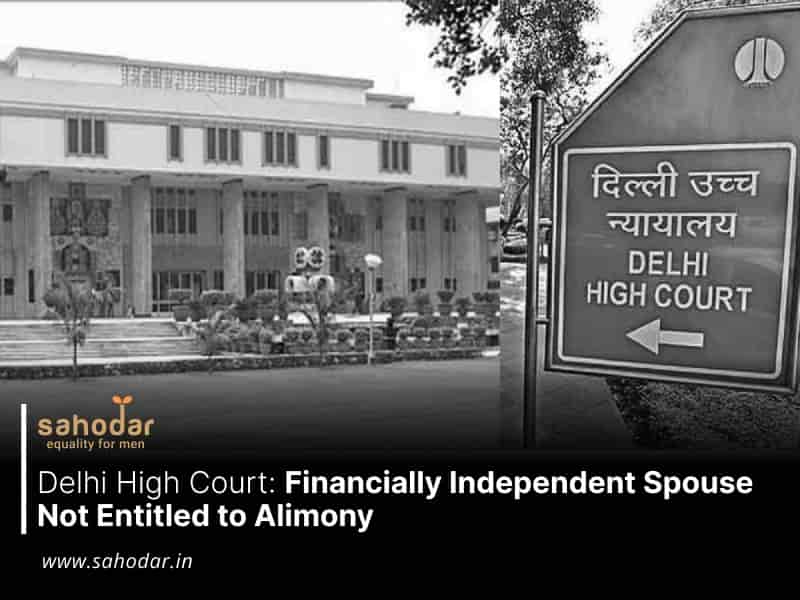
Permanent alimony is intended as a measure of social justice and not as a tool for enrichment or equalising the financial status of two capable individuals, the Court said.
The Delhi High Court recently ruled that a spouse who is financially self-sufficient and independent is not entitled to alimony.
A Division Bench comprising Justices Anil Kshetarpal and Harish Vaidyanathan Shankar observed that permanent alimony serves as a measure of social justice, not as a means for enrichment or to equalize the financial standing of two competent individuals.
The Court emphasized that the law mandates the person seeking alimony to establish a genuine need for financial support.
“Judicial discretion under Section 25 [of Hindu Marriage Act (HMA)] cannot be exercised to award alimony where the applicant is financially self-sufficient and independent, and such discretion must be exercised properly and judiciously, based on the record, the relative financial capacities of the parties, and the absence of any material demonstrating economic vulnerability on the part of the Appellant,” the Court held.
The Bench made these remarks while affirming a family court’s decision that denied permanent alimony to a woman and granted her husband a divorce on grounds of cruelty.
According to the case details, the couple—both previously divorced—were married in January 2010 but separated after just 14 months. The husband was a practising advocate, while the wife served as a Group A officer in the Indian Railway Traffic Service (IRTS).
The husband accused his wife of subjecting him to mental and physical cruelty, including the use of abusive language, sending insulting messages, denying conjugal rights, and causing humiliation in his professional and social life. The wife, however, refuted these claims and counter-alleged cruelty by the husband.
The family court granted a decree of divorce, noting that the wife had sought ₹50 lakh as a financial settlement in exchange for consenting to the dissolution of the marriage—a demand she acknowledged both in her affidavit and during cross-examination.
The family court declined to grant the request.
Upon reviewing the matter, the High Court found no error in the family court’s decision.
The Court observed that when a spouse appears to oppose the dissolution of marriage but conditions their consent on the payment of a significant amount, it suggests that the opposition is driven not by affection, reconciliation, or the desire to preserve the marital relationship, but by financial motives.
“The inference drawn by the learned family court that the Appellant’s approach bore a clear financial dimension cannot be said to be unfounded or unreasonable; rather, it was a logical conclusion based on the evidence before it,” the Bench observed.
Additionally, the High Court observed that the wife had directed abusive language toward the husband, employed offensive epithets against his mother, and branded him as of illegitimate birth, conduct that constituted mental cruelty.
The text messages in question contained imputations of illegitimacy, filthy epithets directed at the Respondent’s mother and other degrading expressions a pattern of conduct which, cumulatively, the learned Family Court was entitled to regard as causing grave mental agony to the Respondent.”
Ultimately, the Court rejected the woman’s claim for alimony, observing that she is a senior government official with a significant income and is financially self-sufficient.
“The short duration of cohabitation, the absence of children, the Appellant‟s substantial and independent income, and the lack of credible evidence of financial necessity cumulatively negate any claim for permanent alimony. Accordingly, we find no justifiable ground to interfere with the findings of the learned Family Court, and the prayer for permanent alimony is therefore rejected,” the Bench concluded.